

First beat fatigue and win offshore
Why your watch system is the one easy fix you may have missed

There are three things offshore sailors rarely talk about properly.
Anxiety. Seasickness. Heads & hygiene.
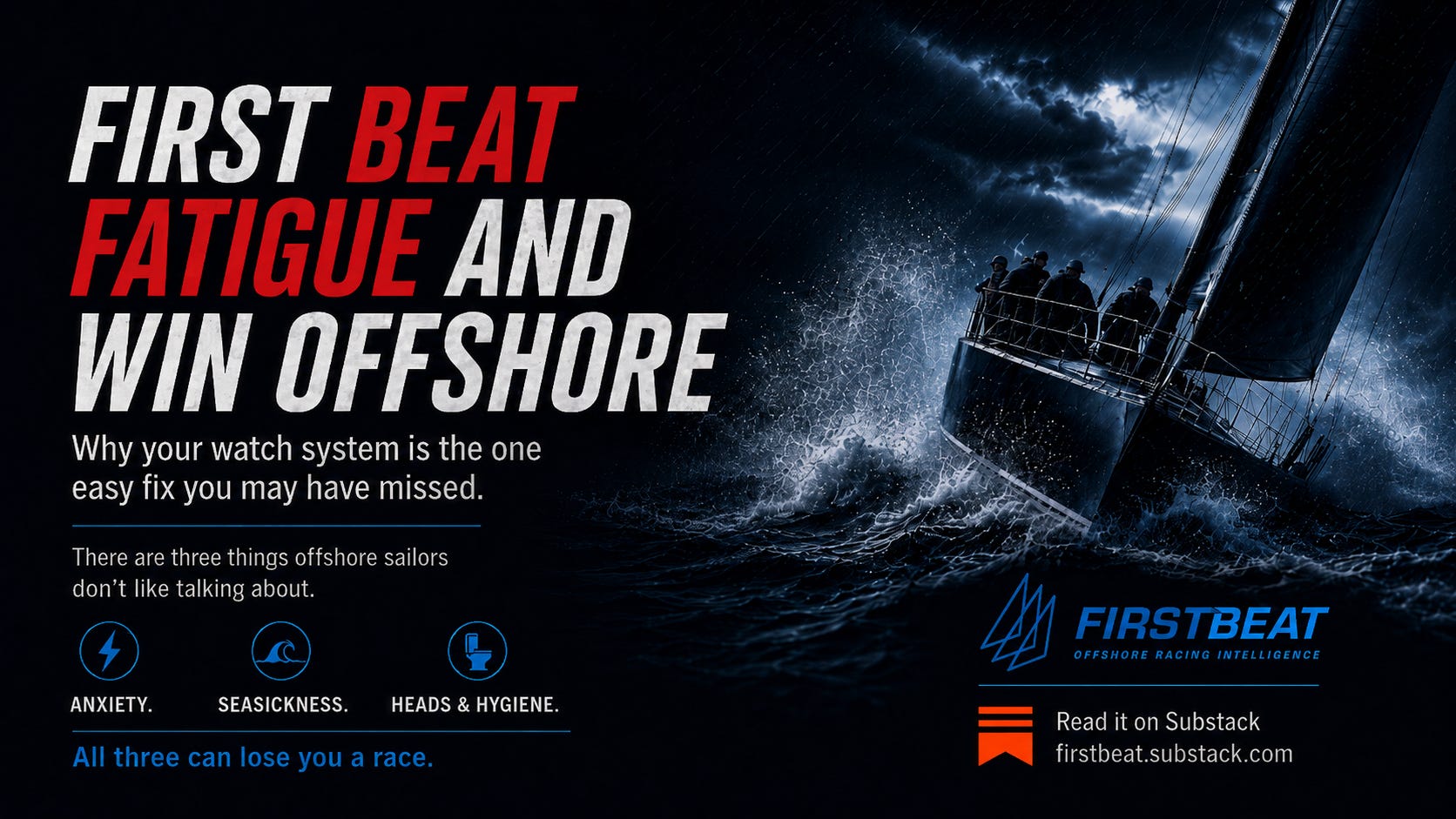
Which is a problem, because all three can quietly lose you a race.
Not usually in some dramatic, helicopter-at-dawn, shredded-main, shouting-at-the-sky moment. More often it happens in the way offshore races are actually lost: slowly, messily, and with everyone pretending things are more under control than they really are.
A crew member who is anxious stops being reactive and becomes passive. A crew member who is seasick stops contributing properly. A crew member who is cold, dehydrated, badly fed, physically uncomfortable or avoiding the heads becomes distracted, irritable, slow and eventually can’t contribute significantly to the team.
That may sound rather basic, even slightly offensive. But it is often the key issue, as I will explain in this article.
By the second night offshore, racing is no longer just about sail choice, routing, tide gates and target speeds. It becomes a test of whether your friends, your crew and your whole floating system can still operate inside a wet, noisy, tilted, uncomfortable yacht that removes privacy and makes simple things very difficult.
Getting dressed becomes an athletic event. Eating becomes logistics. Going to the heads becomes a private negotiation with timing, gravity and dignity. Below decks starts to feel smaller. Wet kit spreads. Smells build. Sleep becomes fragmented. A small worry in daylight becomes a much bigger thing at 0300.
For some crew, particularly women on male-dominated boats, this can be even more awkward. Not because women are less capable, that is obviously untrue, but because privacy, hygiene, cold layers, wet kit and the fairly primitive design of many offshore interiors can make basic personal management harder than it needs to be.
It is not something to ignore or tough out, that’s old school thinking
The crew still has to sleep, eat, drink, pee, stay clean, manage anxiety, avoid seasickness and come on deck ready to do a job. If they cannot, the best race plan in the world cannot be achieved.
That is where the watch system comes in.
Not as a rota. Not as admin. Not as something scribbled down just before the start.
The watch system is the structure that keeps people useful.
It decides who sleeps before the hard bit, who is awake for the transition, who eats before nightfall, who has time to recover from seasickness, who gets a proper handover, and who protects the skipper from becoming the most dangerous tired person on the boat.
Because that is the big one.
The worst fatigue failure offshore is not a tired trimmer. It is a burned-out skipper with no command left.
At that point the boat may still technically be racing, but nobody is really in charge. Not sharply. Not calmly. Not with the judgement the sea demands.
And offshore racing is merciless about that. The tide does not care that your new jib was expensive. The wind does not care that your navigator is usually brilliant. Fatigue certainly does not care that the skipper is a legend.
Fatigue just waits, then starts removing people from the race one decision at a time.
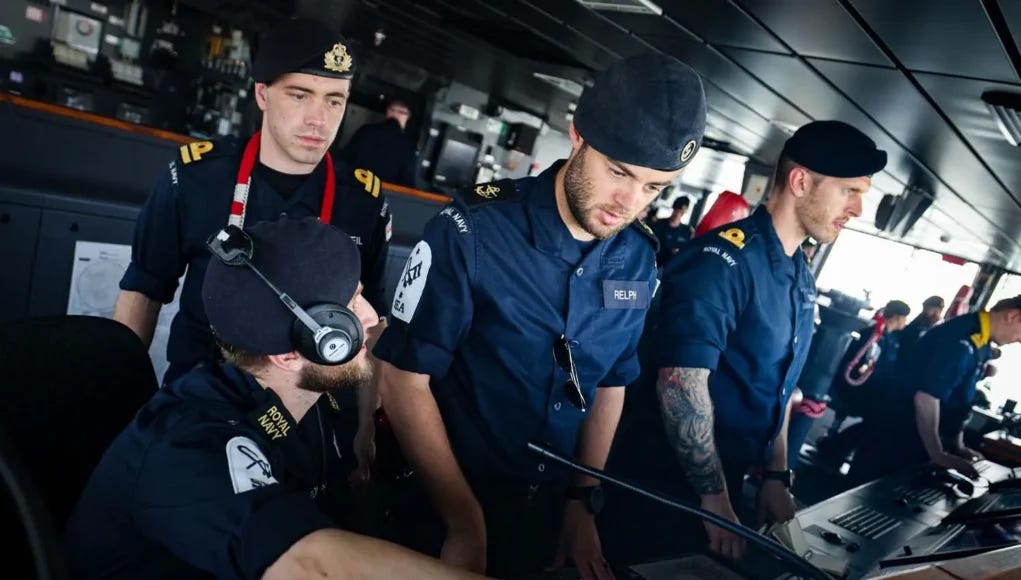
The Royal Navy understood the problem
It’s worth a quick look at the history; The Royal Navy did not invent tired sailors. That probably happened the first time someone climbed into a boat, looked at a grey horizon and thought, “This seems manageable.”
But offshore and ocean yacht racing watchkeeping culture owes a great deal to the naval world.
The old seagoing day was divided into watches because ships had to function continuously. The dog watches, usually the split between 1600–1800 and 1800–2000, stopped the same people getting stuck with the same night watches every day. That was not quaint tradition. It was practical human performance management.
Long before carbon sails, GRIB files, Expedition, Adrena, B&G displays and half the fleet trying to outsmart a weather model, professional seafarers understood one simple truth.
A ship only works if the people still work.
That is what a watch system is for.
Not fairness. Not tradition. Not tidiness.
I learned this fairly quickly as a young Midshipman in the Royal Navy. The middle watch, midnight to four, is where youthful enthusiasm goes to die quietly. I once found myself sleeping in the upper deck radar equipment room because the ship was on a major exercise and full, which I do not think was part of the official leadership syllabus, but as I was on watch most of the time and the most junior officer on board you kept quiet and tried to stay awake!
I learnt a few lessons from that.
Fatigue does not arrive like a storm front. It creeps in. It makes clever people stupid, strong people clumsy and good sailors slow. Left unchecked, it turns a racing yacht, even a warship, from a weapon into something very dangerous.
Fatigue is not weakness
Fatigue is not weakness. It is biology.
Maritime fatigue guidance describes it as tiredness caused by prolonged work, anxiety, harsh environments or lack of sleep. The result is impaired performance and reduced alertness.
The official language is dry, but the offshore version is easy to recognise.
It is the helm no longer feeling the waves. The trimmer who stops seeing pressure. The bow team that miss something obvious. The navigator who stops questioning the model. The skipper who stays awake because everyone else looks worse.
That is why the watch system matters.
It is not there to make people comfortable. Offshore racing is not comfortable. If comfort is the main objective, Cowes has hotels and some of them have very good balconies.
A good watch system keeps people useful.
That is the whole game.
Anxiety: the quiet performance leak
Anxiety offshore is normal. We should probably say that more often.
A new crew member may be worried about looking stupid. A bowman may be worried about a night change in breeze. A helm may be worried about wiping out. A navigator may be worried the model is wrong. A skipper may be carrying the whole boat in his head while pretending to look relaxed.
Most sailors do not call this anxiety. They call it caution, being quiet, not wanting to get in the way, or feeling a bit off.
Sometimes that is true. Sometimes it is anxiety.
The problem is not anxiety itself. The problem is unspoken anxiety.
That is when people freeze, overthink, stop asking simple questions, hide seasickness, avoid the heads, or pretend they are fine when they are not. Small human problems then become boat problems.
A good watch system helps because it gives the crew rhythm, expectation and permission. People know when they are on, when they are off, who they report to, when they are supposed to eat, when they are supposed to sleep, and when they need to speak up.
Structure reduces anxiety.
Free subscribers get the key points. Paid subscribers get the full race-winning detail.
I’ll always publish useful free material, but paid subscribers get the deeper tactical analysis and practical guides.
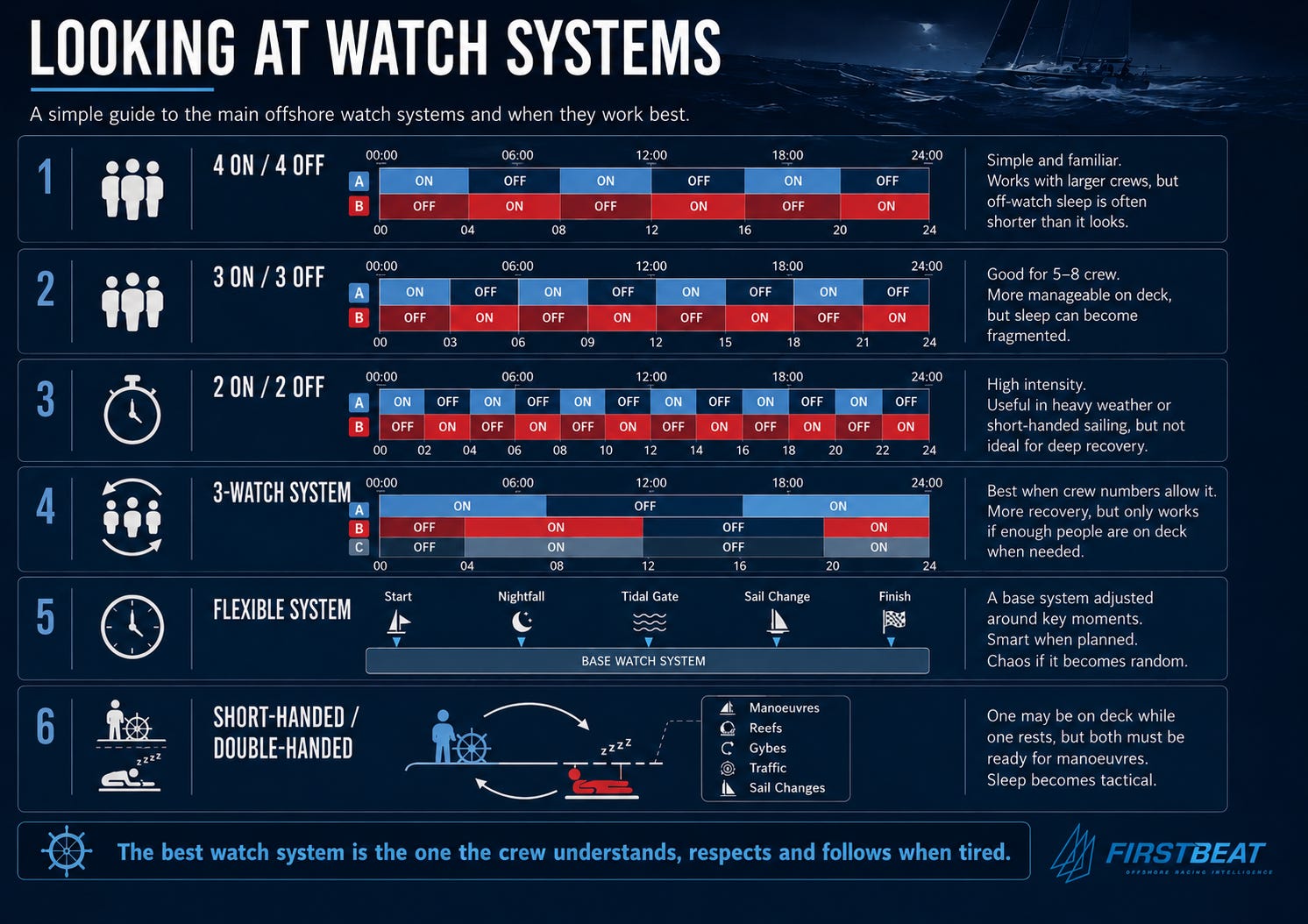
The main watch systems
There is no perfect watch system.
The best one is the one the crew actually understands, respects and follows when they are cold, hungry, seasick and not quite as clever as they were at the dock.
But there are common patterns, and each has strengths and traps.
Four on / four off
Four on / four off is the old classic. Simple, familiar and brutal.
With enough people it can work well, especially on bigger crews. Four hours on deck gives continuity, and four hours off sounds like enough time to recover.
The problem is that four hours off is never really four hours off.
By the time someone has come below, removed wet gear, found a bunk, eaten something that may once have been pasta, sorted kit, tried to sleep and then been woken early because the kite is coming down, that beautiful four-hour rest period may have become 87 minutes and a biscuit.
To prevent every day becoming the same watch — nobody likes the middle watch every day — a dog-watch system can be added. The traditional dog watches, 1600–1800 and 1800–2000, create an odd number of watches and are also a useful time for all watches to eat before dark in a UK summer.
Three on / three off
Three on / three off often feels more manageable. Three hours on deck is not too long. Three hours below is not complete fantasy, especially in cold, trying conditions.
For many RORC-style races, especially with five to eight crew, it can work well. The downside is fragmentation. People are always moving, and the boat can start to feel like a conveyor belt of damp humans never quite asleep and never quite awake.
It is good for intensity. It is less good for deep recovery.
Two on / two off
Two on / two off is the espresso martini of watch systems.
It sounds exciting, keeps everyone buzzing for a while, and then suddenly nobody is at 100% efficiency.
It can work in cold conditions, heavy weather, high-intensity sections or short-handed sailing where concentration drops quickly and workload is intense. But it is not a magic answer.
On double-handed boats, reality is usually more subtle than a neat two-on, two-off rota. For long stretches, one sailor may be managing the boat while the other rests below. But both need to be available for manoeuvres, traffic, sail changes, reefs, gybes and those moments when the boat suddenly demands more than one tired human.
On a normal fully crewed offshore boat, two on / two off can destroy real sleep if used for too long.
Useful tool, use carefully
Three-watch systems
If there are enough people, three watches can make offshore life more civilised.
A proper three-watch system can give longer recovery and keep the boat sharper deeper into the race. The problem is numbers. On a five-person boat, a true three-watch system may leave too few useful people on deck. On a bigger boat, it can be excellent.
The question is not whether the rota looks fair. The question is whether the boat can still manoeuvre, trim, navigate and respond when the next hard moment arrives.
Many maxi sized yachts (class Zero) run three watches, one on deck, one ready in kit below, one in bunks or make and mend, food prep etc.
Buddy system
This is where the crew splits into pairs, with similar skills, one is on deck when the other is below. You decide on work loads and tiredness if your buddy goes down for 1,2,3 or 4 hours. You must work as a team and share your plan with rest of team and monitor each other for signs of tiredness and seasickness. During a transition or “all hands” moment, the buddy below joins the deck team.
Flexible watch systems
Many good offshore boats use a base structure, then flex it around critical moments.
That means starts, Solent exits, nightfall, tidal gates, headlands, sail changes, weather transitions, traffic, heavy weather and the finish approach.
That is sensible. The sea does not care what the laminated sheet says.
But flexible must not mean random.
“Let’s see how it goes” is not a watch system.
It is a confession.
Short-handed and double-handed boats are different
Short-handed sailing is not a smaller version of fully crewed sailing. A double-handed boat is not simply a full crew with fewer people. It is a different operating system.
For much of a double-handed race, one person may be actively on deck while the other is below trying to sleep, eat, navigate, recover, or simply shut their eyes before the next transition. But off watch does not mean unavailable.
Both sailors usually need to be ready for the important moments: sail changes, gybes, reefs, traffic, headlands, tidal gates, weather transitions, starts, finishes and anything involving a spinnaker at night combined with poor judgement.
So the watch system becomes less about fairness and more about protecting function.
Who can safely manage the boat alone? Who needs sleep before the next hard section? Who is better at night? Who can navigate tired? Who gets seasick? Who needs to be awake for the next manoeuvre? Who must not be allowed to overdo it.
That is why double-handed sailing is so demanding. From the outside the boat can look calm. Inside, it is a constant negotiation between sleep, seamanship, weather, risk and timing.
Three-handed boats sit somewhere between double-handed and fully crewed. Sometimes one person may be on deck while two rest. Sometimes two are needed on deck while one is protected. Conditions decide. The same principle applies.
The watch system has to follow the race, not someone’s tidy idea of equal suffering.
In short-handed racing, sleep is not a reward.
It is a tactical resource.
When to be cautious:
The watch handover is where time and distance can easily be lost and it’s not noticed
A watch change should not be a sleepy grunt at the companionway.
“Wind’s a bit left. Don’t hit France.”
That is not a handover. That’s plainly dangerous
A proper handover needs to tell the new watch what the boat is actually trying to do. Course, mode, true wind, sail plan, likely next change, traffic, tide, waypoint, anything broken, anything bodged, anything suspicious, who is tired, who is seasick, and what the skipper or navigator wants next.
The off-watch should go below knowing the objective. The on-watch should come on deck already briefed enough not to spend the first 20 minutes asking obvious questions into the spray.
Standing orders matter
On every well-run offshore boat, the skipper should set clear standing orders before the start.
These are the boat’s basic command rules. They make clear what the watch leader, helm, navigator and crew are allowed to do on their own, and what must come back to the skipper before any executive decision is made.
Can the watch gybe without waking the skipper? Can they reef? Can they change headsail? Can they alter course significantly? Can they start the engine in an emergency? When must the skipper be called immediately?
This is not about ego. It is about command, safety and responsibility.
At sea, the skipper carries a level of responsibility that is different from most situations ashore. MCA guidance states that the master/skipper has overall responsibility for the safety of everyone on board and for the safety of the vessel, and that their instructions must be followed. COLREG Rule 2 also makes clear that a vessel, owner, master or crew cannot escape the consequences of neglecting the collision rules or the ordinary practice of seamen.
On commercial ships this is formalised through the Master’s Standing Orders and Night Orders. MCA watchkeeping guidance refers directly to standing orders and the Master’s night orders being fully understood by the relieving watch. On a racing yacht it may be less formal, but the principle is exactly the same.
Before the start, the skipper should brief the crew on the standing orders. If they do not, a good crew member should ask.
Not because they are challenging the skipper.
Because they are helping the boat stay safe, clear and fast when everyone is tired.
Seasickness: the silent (sometimes) crew killer
Seasickness is not weakness. It is not moral failure. It is not a character defect.
It can be unavoidable
The mistake is pretending it is not happening.
A seasick crew member is temporarily removed from the operating system. They may still be clipped on, wearing good kit and making brave noises, but their useful output has fallen through the floor.
So planning for it and discussing it on the dock and 24hrs before the race is the right plan.
Every crew member should know their own history before the race. If someone gets seasick, they should say so. If they think they might get seasick, they should say so. If they have never been offshore at night in a confused sea after eating a service-station sandwich, they should assume they will be.
Medication needs to be tested before the race, not discovered halfway across the Channel. Some common travel sickness medication can cause drowsiness. That matters offshore, because solving nausea by making someone sleepy may create a different problem if that person is expected to helm, trim or make decisions at night.
So the rule is simple: know your plan, test your plan, and tell the skipper your plan.
The skipper also needs to think about it before the start. Who is likely to suffer? Who replaces them? Can they still sit rail, steer or trim? Are they better on deck than below? Do they need to stay out of the nav station? At what point are they removed from critical tasks?
A seasick crew member is not a disappointment.
An unplanned seasick crew member is.
My rule is to reduce caffeine 36 hours before the race, take your choice of seasickness pill the night before the race, and top up before the start — always reading the instructions.
Heads & hygiene: the unglamorous performance system
Now for the unglamorous bit - but essential to discuss with everyone
Heads and hygiene.
Offshore sailors love talking about sailcloth, carbon, routing software, keel shape and whether the new J4 was worth the money. They are less keen to talk about blocked heads, personal hygiene and the practical reality of keeping a crew functional inside a racing yacht.
That is a mistake.
A dirty boat below is inefficient. A smelly boat is a sign of a problem. A blocked heads at night is not character-building. It is poor preparation.
And yes, bodily timing matters.
People who are dehydrated, embarrassed, cold, seasick, badly fed or avoiding the heads become uncomfortable. Then distracted. Then irritable. Then slow. Then you have a problem.
This is not crude. It is seamanship.
On a short race, a crew might get away with a certain amount of biological decline. On a longer offshore race, hygiene becomes performance. The heads are not a private inconvenience. They are part of the boat’s operating system.
Crews need simple rules. Use the heads early. Hydrate early. Eat food your body understands. Do not leave everything until the boat is launching off waves at 25 degrees of heel. Do not block the system with wipes. Report problems immediately. Keep wet kit away from bunks. Keep food areas clean. Keep personal gear contained. Leave the boat better for the next watch. If it didn’t pass through your body don’t put it down the heads. Men should sit down to pee in rough weather. Sometimes a bucket is easier to sit on than the heads as it moves with you and the contents can be carefully tipped over the side, no seacocks to open and close no pump to jam. It sounds counter-intuitive but it is tried and tested and can avoid mess, be quick especially if you already feel ill.
This matters for everyone, but it particularly matters on mixed crews. A well-run boat makes privacy, hygiene and personal management normal. A badly run boat turns basic human needs into embarrassment.
The boat is a closed system. Everything ignored comes back eventually, usually at night, usually in foul weather, and usually just after the skipper has finally gone to sleep.
Potentially one of the most dangerous mistakes: skipper burnout.
Not crew tiredness. Not one seasick trimmer. Not a bad meal plan. The skipper burning out is the big one, because once command is gone, everything else degrades.
The classic phrase is, “Wake me if anything changes.”
Unfortunately, everything changes offshore. Wind, tide, sea state, crew condition, race position, weather timing, boat speed, risk. After 30 hours awake, the skipper changes too.
Protecting the skipper’s sleep is not indulgence. It is command management.
Another common mistake is putting all the best sailors on one watch. That creates one strong watch and one supervised accident. Each watch needs competence: someone who can steer, someone who can trim, someone who can think, and someone who notices when the boat feels wrong.
The navigator is another trap. Treating the navigator like ordinary crew can be expensive. Anyone who has watched a navigator eat cereal while arguing with a GRIB file knows they are not entirely normal, but they are part of the boat’s brain. If they need to be sharp for a tide gate, headland, weather transition or routing call, do not burn them out trimming jib for four hours because “everyone mucks in.”
Everyone does muck in. But brains are part of the inventory.
Then there is the late wake-up. If the kite drop is in ten minutes, do not wake people in nine. Cold, half-dressed people are not useful. Wake early, brief properly and give people time to become human.
The last big mistake is confusing being awake with being useful.
Offshore sailing has a disease where people think endurance means staying up longest. It does not.
Endurance means still being able to do the job when the job matters.
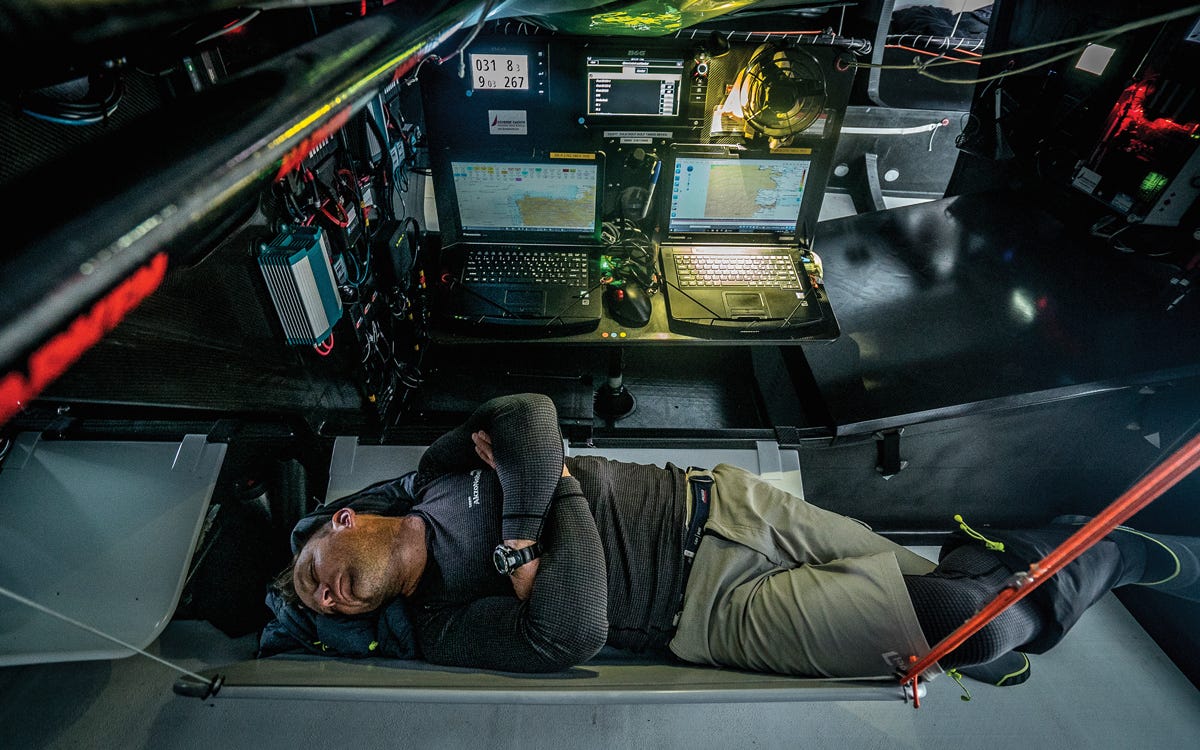
The crew member’s survival guide
This is the part every crew member should read before the race.
Before the race, get some proper sleep. Not just the night before, but ideally for two nights. Do not arrive already tired and call it commitment.
Sort out seasickness before the start. Test medication beforehand. Speak to a pharmacist or doctor if unsure. Do not take something new offshore for the first time and hope for the best.
Eat sensibly before the race. Hydrate before the race. Use the heads before leaving, and if you need to go early in the race, go early. Do not wait until the boat is slamming, the cabin smells like a wet dog’s legal defence, and dignity has become a theoretical concept.
Pack less, but pack better (dry bag items). Keep dry kit dry and wet kit contained. Make sure the headtorch works, gloves are accessible, snacks are where they should be, lifejacket is checked, knife and tether are sorted, and layers are packed for what the race will actually feel like at night.
Know the watch system before leaving the dock. If it is not clear, ask.
Before coming on watch, wake early enough to become useful. Get dressed properly. Clip on properly. Drink water. Eat something if needed. Use the heads if needed. Check gloves and headtorch before appearing at the companionway.
When you come up, listen first. Find out the mode, sail plan, course, wind trend, next manoeuvre, danger and plan. Then do the job.
If trimming, trim. If helming, helm. If you are on the rail, be the best. If on lookout, actually look out.
If anxious, ask what needs to be understood. If cold, say so early. If seasick, say so early. If something feels wrong, say so clearly.
Do not sit there silently watching the boat get slower because you are worried about upsetting someone. Equally, do not narrate every private thought into the cockpit like a man reviewing a new boat.
Good crew communicate useful information.
When going off watch, leave the next watch a better boat. Coil what needs coiling, clear what needs clearing, report what changed, pass on what matters, drink water, eat if needed, get out of wet gear and sleep.
Do not waste half the off-watch chatting, scrolling, faffing, or explaining a theory about the tide to someone trying to do his job.
Rest is also a job.
Do it properly.
First beat fatigue - final thoughts
Offshore racing is cumulative. That is the bit people forget.
Races are rarely lost in one heroic disaster. More often, the loss comes in small pieces.
A poor handover costs a little speed. Missed sleep costs judgement. Unmanaged anxiety costs confidence. A cold crew member costs trim. A dirty boat costs morale. A skipper who stays awake too long costs command. A seasick sailor who should have spoken earlier costs performance. A navigator who needed rest before the decision, not after it, costs sharpness. But keep it fun, and leave any personal issues that do not involve safety or speed for the dock. Nobody has to love everyone in a big crew, but offshore is not the place to settle scores.
Then dawn arrives.
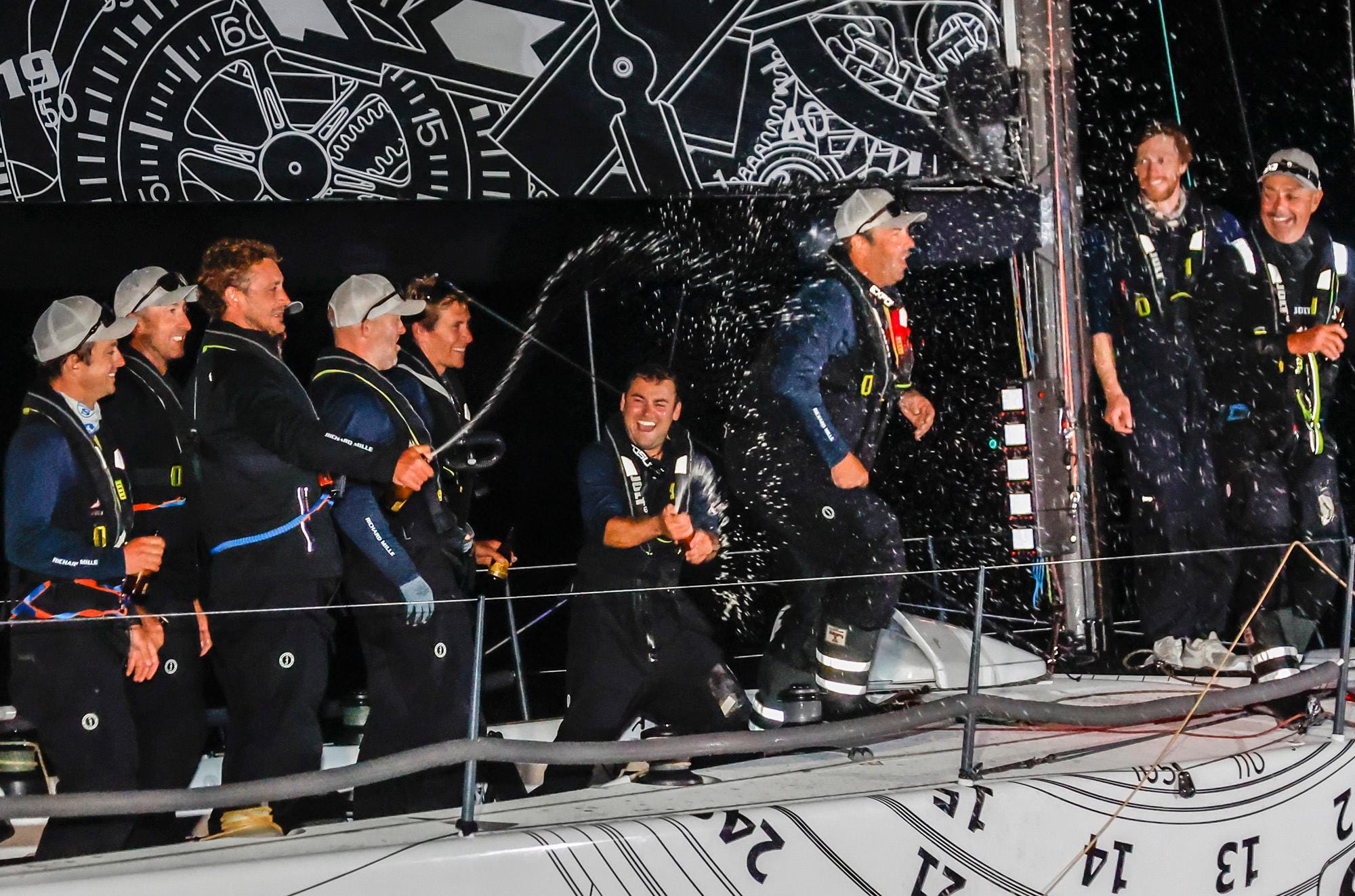
The boats that managed themselves properly are still racing. The others are surviving.
And survival rarely wins offshore.
So yes, obsess about routing. Obsess about tide. Obsess about sail selection. Obsess about boat speed.
But do not miss this easy fix.
Build a watch system the crew understands. Protect the skipper. Protect the navigator. Feed people. Hydrate people. Manage seasickness honestly. Treat anxiety as information, not weakness. Keep the boat clean. Make handovers sacred.
The best offshore crews are not the ones who pretend they do not get tired. They are the ones who know fatigue is coming and have already beaten it to the next transition.
That is how you win offshore.
Not by pretending the crew are machines, but by building a system that keeps them human for longer than the boat next to you.
And if you are not sure how to do that before the next RORC race, get help before the start.
Not at 0300, when half the crew are asleep, one is green, the heads are blocked, the navigator is hallucinating tide arrows, and the skipper is staring at the chartplotter like it owes him money.
Stuart Greenfield
FirstBeat — Offshore Racing Intelligence
Offshore Racing Coach
Former America’s Cup and Admiral’s Cup sailor; 200+ offshore races
RYA Yachtmaster Offshore, Commercially Endorsed
Helping crews sail faster, think clearer, and win the right decisions offshore.
