

Keeping Power Offshore - watt fun!
I'm talking about managing power in racing yachts and why its got stupid

Introduction
A modern offshore racing yacht is not a great statement for a green or low energy philosophy, and that’s a bit of an understatement.
So thisis probably where this discussion has to start for this article.
A racing yacht maybe be driven by the wind, but it is generally made from glass fibre, resin, carbon, foam, stainless steel, aluminium, rope, antifoul, electronics, batteries, diesel, hydraulic oil and a wardrobe of high-tech sails that did not grow organically in a field. (Some effort by some lofts is being made to ensure sails can be recycled but it is a slow climb at the moment).
So when someone bolts a few solar panels on the coachroof, adds a fuel cell under a bunk, buys a lithium battery and starts talking as if the boat has become environmentally pure, we need to be really careful. Car manufacturing has come a long way and most manufacturers, by law, have to build cars with a high level of recycling ability after their usable life, for the yacht building sector this does not apply.
But this does not mean the subject is pointless. Quite the opposite. Power management offshore is one of the most important practical subjects on a race boat, and it is becoming more important every year, especially when power hungry systems like autohelms can be used contunously on all race boats under RORC special regulations and in many cases, especially on double handed boats, they actually become an important safety aspect for the yachts safe passage.
The question is not whether a racing yacht can suddenly become “green”. In almost all cases, it cannot.
The better question is whether we can reduce diesel running, reduce waste, extend equipment life, make smarter choices about batteries and generation, and still keep the boat racing properly.
That is a serious question and I hope this article addresses some of the issues
Chapter list
The green lie we tell ourselves
Power is not a comfort issue
Start with the load, not the technology
Batteries: lead, lithium, NiCad and portable energy blocks
Solar, hydro, fuel cells and diesel
The engine-start battery must remain sacred
Alternators, regulation and the car-alternator problem
Battery monitors are not decoration
Managing power in a real offshore race
The small details that stop big failures
1. The green lie we tell ourselves
There is no point writing about cleaner offshore power without facing the awkward bit.
Composite boats create end-of-life problems. European Boating Industry identifies end-of-life boats as one of the nautical industry’s major circular economy challenges, especially because of recycling and disposal issues around composite construction. That matters because offshore racing is full of GRP, carbon and other composite structures that are difficult to recover cleanly at the end of life.
Sails are not innocent either. Modern race sails are often made from advanced synthetic fibres, films and laminates. They are light, efficient and expensive, but they are not simple natural objects. Add shipping, chase boats, support vehicles, antifoul, electronics, safety kit, resin, metals and diesel, and the idea that a race boat becomes green because it has solar panels is obviously weak.
The fact that offshore racing is imperfect does not mean we should make no effort. It means we should stop using lazy language. A solar panel does not make a carbon race boat green. A fuel cell does not absolve a diesel engine or even electric propulsion systems. A lithium battery does not make a campaign sustainable by itself.
What these things can do, if properly chosen and properly managed, is reduce waste, reduce engine running, improve reliability and make the boat less dependent on burning diesel simply to keep the instruments alive.
That is worth doing.
But let us call it what it is: better energy discipline.
2. Offshore, electrical power is no longer a convenience.
It is not just about charging phones, boiling water, watching the tracker or keeping the nav station looking modern. Those are the soft edges of the subject. The hard truth is that almost every serious offshore racing boat now depends on power to navigate, communicate, avoid collision, monitor weather, steer, keep watch and make decisions.
That is a fundamental change.
Forty or fifty years ago, a good offshore crew could race with paper charts, compass, sextant, trailing log, hand-bearing compass, VHF, flares and judgement. Many did extraordinary things with very little. But that does not mean a modern boat can simply lose power and carry on as if nothing has happened.
The sea has not become simpler. The traffic has increased. The boats are faster, closing speeds are higher, safety expectations are different, and most modern crews are not trained to race as if it were 1978.
Take the power away and you have not just lost comfort. You have changed the boat. Instruments go dark. AIS disappears. The pilot may stop steering. Weather and routing data may vanish. Communications may be reduced. The navigator is suddenly trying to rebuild the race with backup methods that may not have been practised under pressure.
Traditional navigation still matters. It always will. But traditional skill is not an excuse for poor electrical preparation.
The Golden Globe Race is a useful comparison. It deliberately restricts competitors to a style of sailing based around equipment available in the late 1960s and 1970s. But that is a chosen discipline. The boats, rules, preparation and mindset are built around it, and even then, modern emergency systems such as EPIRBs and sealed emergency communications remain part of the safety framework.
That is very different from a modern RORC or IRC boat losing power accidentally halfway through a race.
One is a discipline.
The other is a failure.
So when we talk about batteries, alternators, regulators, solar, fuel cells and battery monitors, we are not talking about gadgets.
We are talking about keeping the boat able to see, think, steer, communicate and race when the easy part is over.
Power runs the race.
It runs the instruments, the autopilot, the AIS, the VHF, the mast displays, the nav lights, the GPS, the laptop, the router, the tracker, the satellite link, the bilge pumps, the watermaker on bigger boats, the keel systems on some larger race yachts and the entire nervous system of the boat.
It also runs the human side of the boat.
Phones, head torches, watches, handheld VHFs, cameras, tablets, battery banks, heated clothing, GoPros and all the little personal electronics that crews now bring offshore.
You can be as old-school as you like, but by the second night a flat phone can become a morale issue. It should not be the skipper’s main problem, but pretending it does not matter is not realistic either.
Then there is the new load creep.
Starlink, routers, onboard Wi-Fi, tablets, streaming data, laptops running Expedition, Adrena, PredictWind, NavimetriX, AIS overlays, trackers, cameras and whatever other gadgets like music systems, the owner has bolted under the chart table.
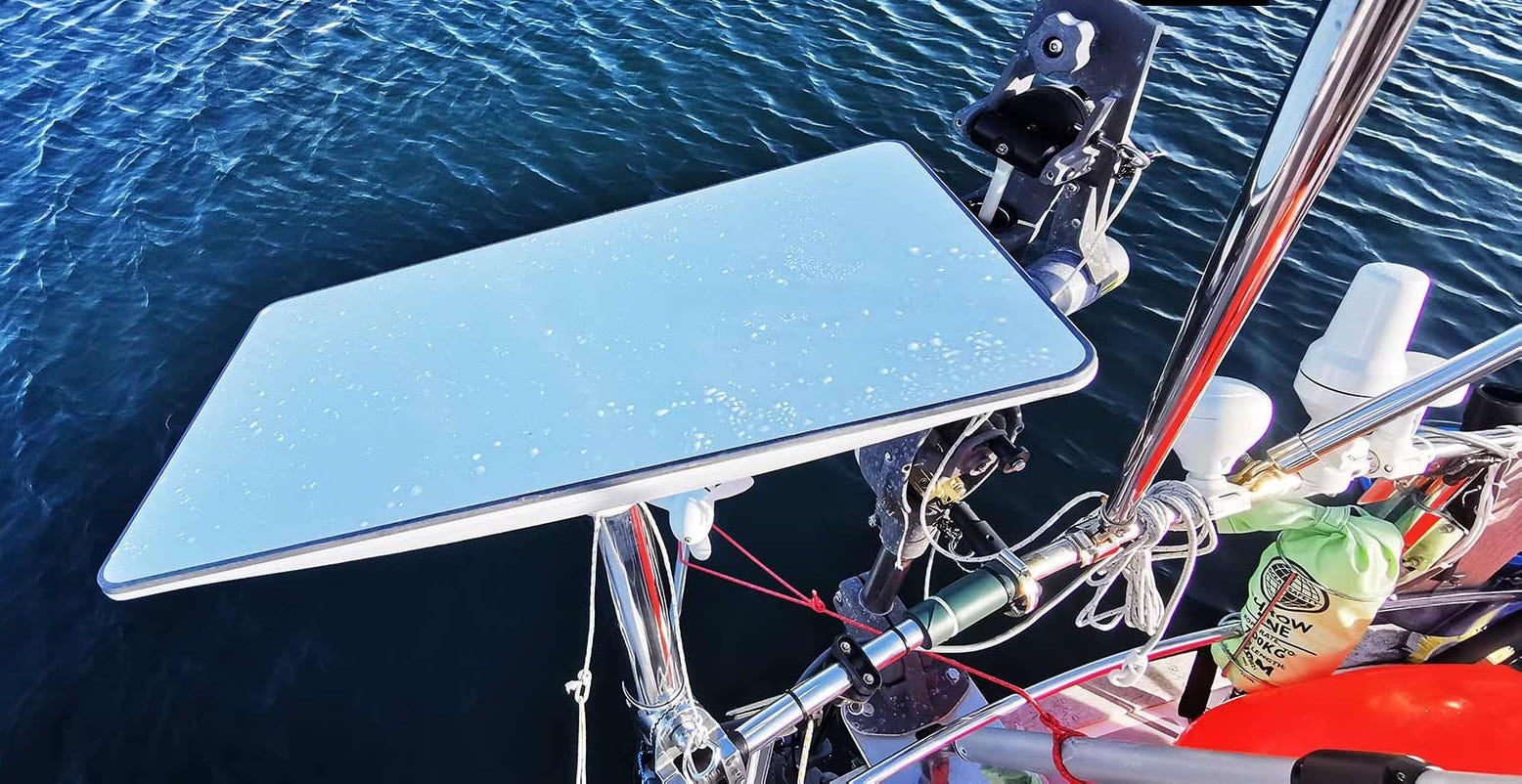
Starlink’s own support information gives Starlink Mini average consumption at 20 to 40 watts, with 15 watts at idle. That does not sound much until someone leaves it running all day and all night on a small offshore boat with limited battery capacity. Over 24 hours, one small box can become a serious part of the energy budget.
This is why power offshore has to be treated as seamanship.
Not as an afterthought.
Not as something the owner “has probably sorted”.
Not as something solved by buying a bigger battery.
A boat that does not understand its power use is a boat waiting for a problem
3. Start with the load, not the technology
Most people approach yacht power backwards.
They start with the product.
Should we buy lithium?
Should we add solar?
Do we need a fuel cell?
Can we fit a hydrogenerator?
Is the alternator big enough?
Those are not the first questions.
The first question is: what does the boat actually consume in a real offshore race?
At night, with instruments on, nav lights on, AIS on, laptop on, pilot working, wet crew below, phones charging, data coming in, pumps cycling, a tablet running, a router left on and someone trying to download weather because the fleet has just split.
Until you know that number, every battery and generation conversation is partly guesswork.
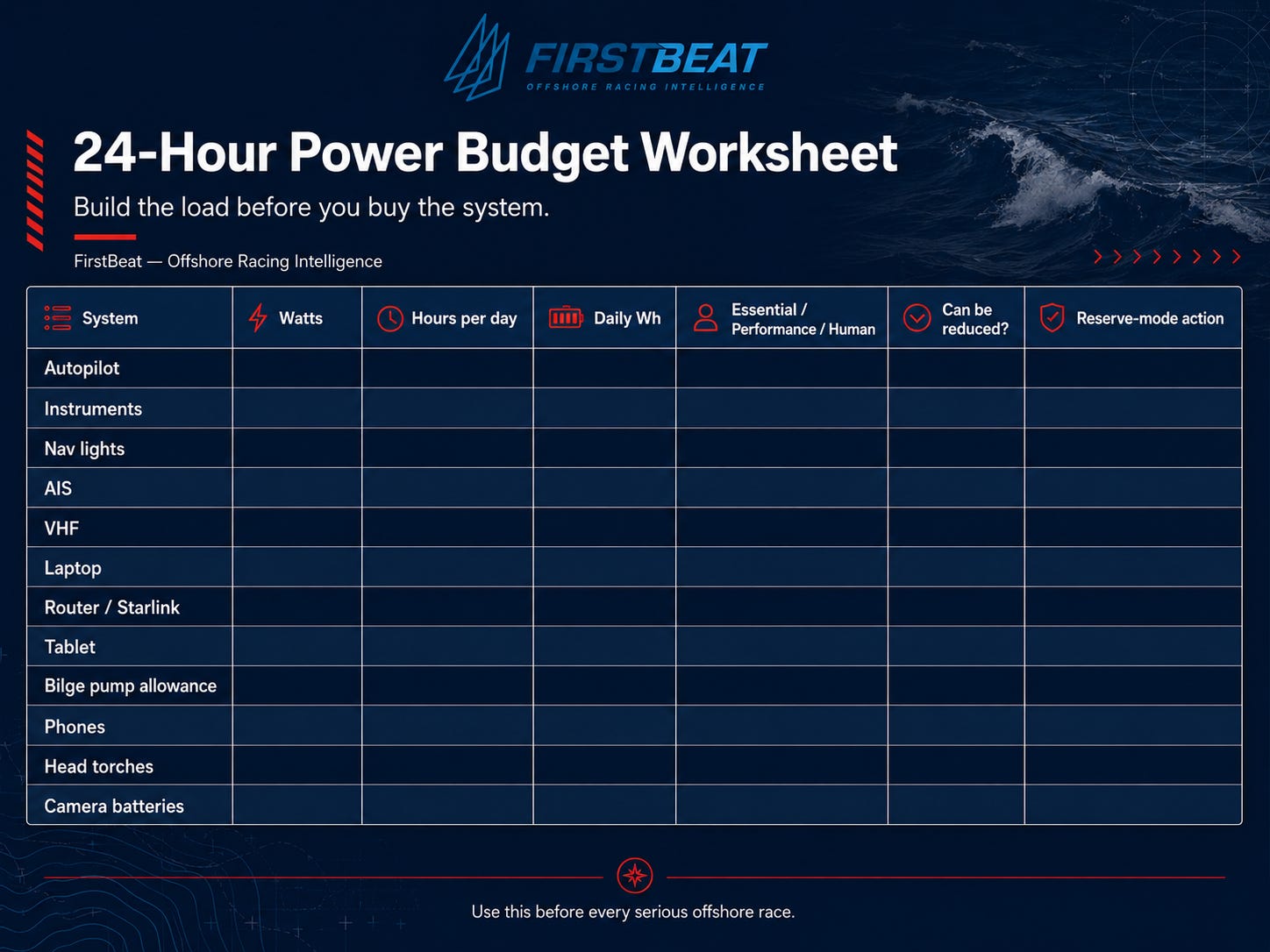
So you list every load. You write down the watts, the hours used and the total watt-hours. For a 12-volt boat, you can use amps and amp-hours, but watts are often clearer because boats increasingly mix 12V, 24V, USB-C, inverters and portable power stations.
Then you divide the loads into three groups.
Race-critical: instruments, autopilot, AIS, VHF, nav lights, GPS, safety systems, essential comms.
Performance and decision-making: laptop, routing software, tablet, data link, satellite weather, tracker, camera if used for race analysis.
Human and convenience: phones, watches, head torches, cameras, music, heated kit, non-essential charging.
Bigger alternator, bigger battery, bigger solar panel. None of it helps if nobody knows the load.
4. Batteries: lead, lithium, NiCad and portable energy blocks…it’s confusing
People say “lithium” as if all lithium batteries are the same. They are not. People talk about power banks as if they are harmless toys. They are not. People talk about lead-acid as if it is useless. It is not. And occasionally someone talks about NiCad as if it is about to become the next clever yacht-racing answer. That needs care. So I’ve tried to make a bit of sense of it all.
Lead-acid, AGM and Gel
Lead-acid still has a place.
It is heavy, old technology and not exciting, but it is known, relatively cheap, widely understood and still completely valid on many boats.
AGM and Gel batteries are sealed VRLA types. Victron lists AGM design life at 7 to 10 years and Gel design life at 12 years. Victron also notes that AGM batteries have very low internal resistance, making them suitable for high-current discharge applications such as inverters, thrusters and winches.
For a smaller club or RORC boat on a sensible budget, AGM or Gel may still be the right answer.
Not the lightest answer.
Not the most modern answer.
But sometimes the right answer is the one the owner can afford, the crew can understand and the boat electrician can install properly.
The weakness is weight and usable capacity. Lead-acid batteries do not like being deeply discharged. They charge inefficiently near the top of their range and, in practical terms, you often carry a lot of battery weight that you cannot sensibly use.
Trojan Battery’s maintenance guidance is blunt enough: allowing lead-acid batteries to sit in a low state of charge for extended periods decreases capacity and life.
So lead-acid is not dead. But it is no longer the sharp end of offshore power.
Lead-acid works, but it makes you carry a lot of dead weight for energy you cannot properly use.
LiFePO4: probably the modern default
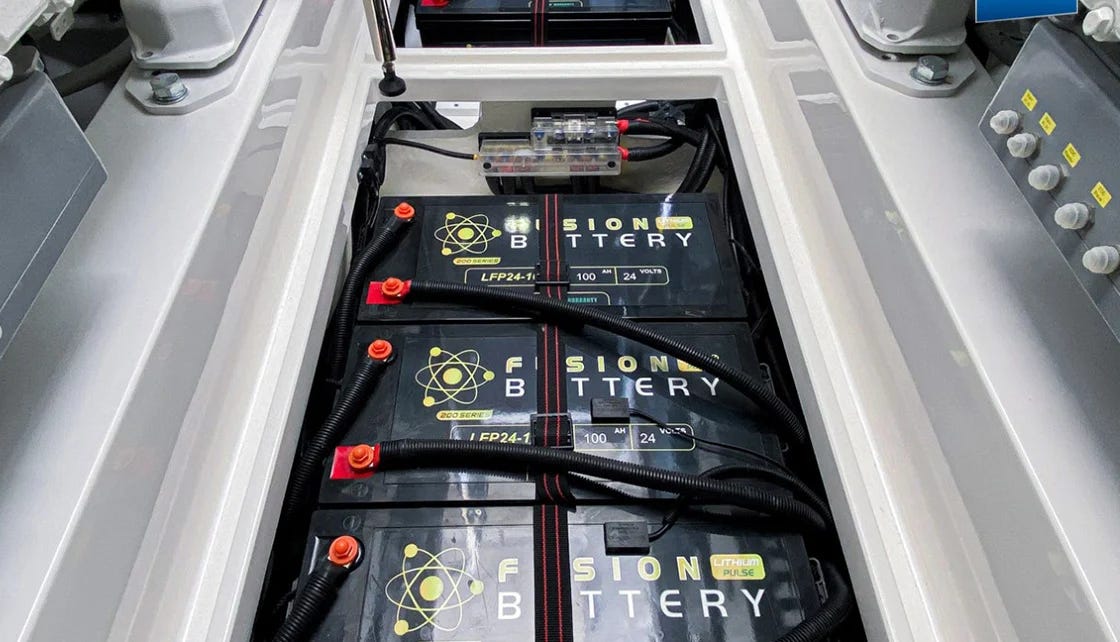
For many serious offshore race boats, LiFePO4, lithium iron phosphate, is now the battery chemistry to examine first.
It gives much more usable capacity for the weight, charges efficiently, cycles well and can reduce a significant amount of dead weight from the boat. Victron’s LiFePO4 technical data gives 92% round-trip efficiency and cycle-life figures of 2,500 cycles at 80% depth of discharge, 3,000 cycles at 70% and 5,000 cycles at 50%, with capacity still at or above 80% of nominal.
A proper LiFePO4 installation needs a battery management system(BMS), correct fusing, isolation, temperature control, alternator protection, correct charging profiles and someone who understands what happens when the BMS disconnects the bank.
The MCA’s marine lithium-ion battery guidance exists for a reason. It describes best practice for safe and environmentally responsible design, installation and operation of lithium-ion batteries on vessels. Bottom line, lithium is excellent when engineered properly. It is dangerous when treated casually.
The FirstBeat view is simple:
LiFePO4 is probably the best modern service-bank solution for many offshore race boats, but only if the installation is professional. Cheap lithium without proper integration is not progress. It is risk with a Bluetooth app.
Smartphone batteries and portable energy blocks
Smartphones, tablets, laptops and most small power banks have changed the way people think about stored energy. They use lithium-ion technology because it is light, compact, energy dense and convenient. We have all become used to carrying a remarkable amount of electrical power in a pocket, a rucksack or a small dry bag.
That familiarity is useful, but it can also be misleading.
A phone battery lives a relatively protected life. It sits inside a sealed consumer device, usually in someone’s pocket, on a desk, in a bunk or in a bag. A race boat battery bank lives in a very different world. It has to cope with salt, vibration, heat, impact, high charging loads, alternator input, solar input, inverter loads, emergency isolation, damp lockers, poor access and, if things go wrong, consequences that are far more serious than a dead phone.
So the lesson from phones is not that we should build yacht systems as if they were enlarged iPhones. The lesson is that lithium has changed expectations. Sailors now expect lighter batteries, faster charging, better usable capacity and cleaner energy management. That is fair enough, but offshore those expectations have to be engineered properly, not improvised under the chart table.
Portable energy blocks, the Jackery, EcoFlow, Bluetti, Anker and similar units, sit somewhere between consumer kit and boat infrastructure. Many of the newer portable power stations now use LiFePO4 chemistry, which makes them more interesting for offshore use than the older generation of small power banks. They can be genuinely useful for phones, tablets, cameras, media equipment, emergency laptop use and sometimes for testing something like a Starlink Mini without rebuilding the boat’s electrical system.
But they are still support kit, not the heart of the boat.
That distinction matters. A portable power station is not usually installed, fused, vented, isolated, secured and integrated in the way a proper yacht battery bank should be. It may not enjoy salt water. It may not enjoy being dropped. It may not enjoy being charged from a doubtful extension lead in a wet nav station while half the crew are cold, tired and pretending they are not seasick.
Used sensibly, one of these units can be a useful secondary layer. It can keep personal electronics away from the main domestic bank, support cameras or comms equipment, and provide a degree of backup if managed properly.
Used badly, it becomes another loose box full of stored energy sliding around the boat, connected to damp cables and treated as if it were a marine electrical system.
That is not innovation.
That is a future incident report.
NiCad: the awkward survivor
Nickel-cadmium batteries, Ni-Cd or NiCad, are worth mentioning because they stop the conversation becoming too simplistic.
NiCad is normally robust, long-lived and still used in specialist industrial, remote-power and marine-related applications.
But it is not the obvious answer for a modern offshore race boat trying to improve its environmental case. UK battery guidance says batteries cannot contain more than 0.002% cadmium by weight unless they are marked and fall into specific categories such as industrial batteries, automotive batteries, or portable batteries for certain emergency, alarm and medical equipment.
Long-lasting is not the same as ecological. Robust is not the same as clean. Industrially defensible is not the same as suitable for your next 38-foot IRC boat.
For most yacht-racing service-bank applications, the conversation should probably be AGM, Gel or LiFePO4, not NiCad.
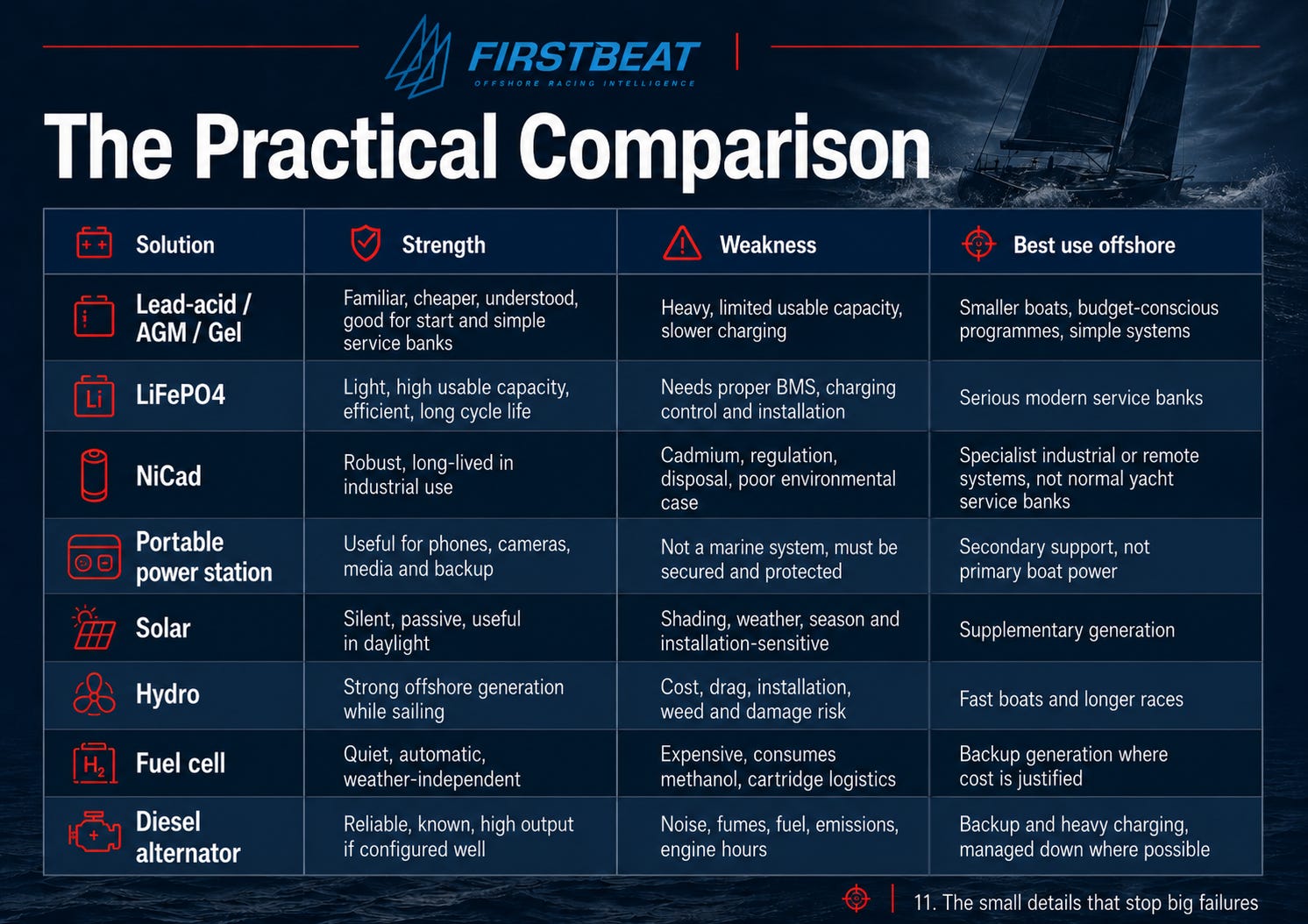
5. Solar, hydro, fuel cells and diesel
Once you understand the load and storage, you can start designing the system and working out the best way to generate and maintain that magic 12V (or 24V) at all times.
Solar: useful, but maybe not on an IRC race boat.
Solar has a place offshore for long distance races over weeks not days even today.
It is silent, has no moving parts and can reduce engine running. Flexible marine panels are now light and efficient. Solbian’s SP series uses back-contact monocrystalline silicon cells and claims 24% conversion efficiency.
Solar output offshore depends on daylight, cloud, latitude, season, panel angle, shading, sail plan, salt, deck layout and whether a crew member has just thrown a wet jacket over half the panel.
On a summer Channel race, solar may contribute usefully during the day. On a wet, overcast autumn race, it may be disappointing. On a boat with panels shaded by sails, crew and rigging, the theoretical output may bear little relationship to the real number.
Solar could work but for the pure racer then useful to have a plug in system for trickle chareging when in the marina.
Hydro: the offshore answer that deserves respect
For offshore racing, hydrogeneration is often more serious than people think.
Solar works when the sun is available.
Hydro works when the boat is moving.
That matters because an offshore race boat spends long periods moving, often at decent speed, and if the boat is fast enough, water generation can be a very strong source of energy.
Watt&Sea says its racing hydrogenerators use a controlled-pitch propeller to minimise drag and optimise output across a speed range of 5 to 30 knots, and says its racing range equipped the entire 2024 Vendée Globe fleet. A UK retailer lists the Watt&Sea Racing 600 as producing 600W at 12 knots, with start-up at 5 knots.
For serious double-handed boats, Class40-style thinking, fast offshore campaigns and longer races, hydro can reduce engine charging dramatically. There is drag, cost, installation complexity and vulnerability to weed or damage, but it is properly aligned with offshore racing because the boat’s motion becomes the source of power.
For IRC race boats in short races, it doesn’t quite add up.
Fuel cells: the next big thing?
Fuel cells are interesting, especially direct methanol units such as EFOY.
They are quiet, automatic, weather-independent and can be valuable on boats that need steady charging without engine noise. EFOY’s technical data lists models delivering 40W, 75W and 125W maximum output, compatible with Gel, AGM and LiFePO4 battery systems.
However, they still consume fuel. They require cartridges. They need space. They need correct installation. They should not be bought to avoid doing the power budget.
For some boats, especially where noise, automatic operation and reliability matter, it may be a sensible solution. For others, the money may be better spent on a properly specified LiFePO4 bank, alternator regulation, solar, a hydrogenerator or simply fixing the boat’s electrical discipline.
A fuel cell is not free energy. It is quiet chemical energy in a cartridge. Useful, yes. Magic, no.
Diesel: the ugly reliability layer
Almost every offshore race boat still has a diesel engine.
Many still use it for charging. Larger boats may also run engines or generators for hydraulic systems, canting keels, watermakers, winches, media systems and high-load electronics. At the grand-prix end, power management is not a matter of a few USB sockets. It is a whole engineered system.
This is where the green conversation often becomes dishonest.
Diesel is noisy, dirty and inefficient when used badly. Running the engine simply because nobody knows the battery state is poor seamanship. Running it unnecessarily because the boat has no discipline is wasteful. Running it at poor charging efficiency because the system is badly designed is also wasteful.
But pretending diesel has disappeared is nonsense.
Diesel remains the ugly reliability layer on many boats.
The practical target should be to reduce engine hours, not lie about them. Use renewable generation where it genuinely works. Build a better battery system where it is justified. Manage loads intelligently. Maintain the engine and alternator properly.
Do not run the engine for hours because everyone charged phones whenever they felt like it and the laptop was left open all night.
6. The engine-start battery must remain sacred
There is one battery mistake that should never happen offshore.
The domestic bank gets dragged down during the race. The instruments have been running all night. The autopilot has been working hard. The laptop has been open. Phones have been charging. The crew have quietly plugged in two more devices than anyone admitted. The boat is wet, tired and slightly behind its power budget.
Then someone starts the engine to charge.
Nothing.
Not a slow start. Not a lazy turn.
The reason is usually simple. The engine-start battery and domestic bank have not been properly separated. Or a 1-2-BOTH switch has been left in the wrong position. Or the emergency parallel switch has been used casually. Or the system is simply not understood by the crew.
The result is that the one battery that should have been protected has been pulled down with everything else.
The engine-start battery should be treated as sacred. It exists to start the engine or generator. It should not be used to run phones, laptops, lights, instruments or domestic loads.
If the boat needs an emergency parallel switch, fine. But it should be clearly labelled, normally isolated and used deliberately, not as part of the normal power routine.
World Sailing’s Offshore Special Regulations require, for relevant monohull and multihull categories, “a dedicated engine/generator starting battery” when an electric starter is the only method of starting the engine or generator.
7. Alternators, regulation and the car-alternator problem
A lot of yacht charging systems are still built around something close to motor car engineering.
A standard internally regulated alternator is often designed around the job of a road vehicle: replace the energy used to start the engine, support modest electrical loads and keep a starting battery topped up.
It is not necessarily designed to spend long periods pushing high current into a large depleted domestic bank in a hot engine compartment while the boat is rolling around in salt water. That difference matters.
A yacht domestic bank may be large. It may be deeply discharged. It may be AGM, Gel or LiFePO4. It may accept current very differently from a car start battery. It may need different charge voltages, temperature compensation, current limiting and proper absorption control.
With lead-acid, poor regulation means slow charging, partial charging, sulphation and shortened battery life. With lithium, poor regulation can be worse.
LiFePO4 has low internal resistance and can demand high alternator output for longer. Balmar’s charging-system guidance notes that lithium batteries can accept an almost unlimited charge load, subject to the battery manufacturer’s recommended charge profile. That is part of the attraction. It is also part of the danger.
A standard alternator may try to deliver more than it can safely sustain. It gets hot. The belt works hard. The case temperature rises. Output falls. In the worst case, it cooks itself.
Then there is the BMS issue. If a lithium battery management system disconnects suddenly because of over-voltage, under-voltage, temperature or another protection event, the alternator can see damaging voltage spikes. Balmar specifically identifies voltage spikes caused by lithium battery shutdowns, intermittent connections and other over-voltage events as alternator risks.
So the point is not simply: “fit a bigger alternator.”
A bigger alternator without proper control can just become a bigger problem.
The better solution is usually one of these.
A high-output marine alternator with an external smart regulator.
This allows proper multi-stage charging, battery-specific profiles, temperature sensing, current limiting and alternator protection.
A DC-DC charger between alternator/start battery and domestic bank.
Victron’s Orion-Tr Smart DC-DC charger is described as an adaptive three-stage charger for dual-battery systems in vehicles or boats, where the starter battery and alternator are used to charge the service battery. Victron’s marine systems material also says its Buck-Boost DC-DC converter will current-limit and protect the alternator against overheating when charging lithium.
A proper external regulator with temperature sensing.
Balmar’s multi-stage regulator information describes alternator and battery temperature sensing and control, including reduction of charging output when battery temperatures exceed safe operating levels. Wakespeed’s WS500 is another example of an advanced alternator regulator using current, voltage and temperature to control charging for lead-acid and LiFePO4 banks.
An alternator protection module.
Especially relevant where lithium banks are installed and BMS shutdown is a possible failure mode.
A separate alternator arrangement.
One alternator looks after the start battery. Another externally regulated alternator charges the house bank. That is not always practical on smaller boats, but the logic is strong where space, budget and installation quality allow it.
This is the FirstBeat point:
The alternator is not just an engine accessory. Offshore, it is part of the race power system. Treat it accordingly.
8. Battery monitors are not decoration
A proper battery monitor should become part of the watch system and in many navigation products they are built in, but you have to find the screen.
A good monitor should show state of charge, voltage, current in or out, watts, amp-hours consumed, time remaining, starter-battery voltage if configured and battery temperature if monitored. It might be best to have a standalone system on a race boat.
Victron’s SmartShunt manual explains that the battery monitor continuously measures current in and out of the battery, integrates that current over time and uses it to calculate amp-hours removed or added. Its operation guide says the main function of the battery monitor is to indicate state of charge and help prevent unexpected total discharge.
But the monitor must be configured properly.
Wrong battery capacity, wrong charge efficiency, wrong Peukert setting, wrong synchronisation or wrong discharge floor, and the monitor can tell a convincing lie.
That is dangerous because a convincing lie on a race boat is often worse than no information at all.
The race procedure should be simple.
Before the start, fully charge and synchronise the monitor.
Write the expected 24-hour consumption in the race notes.
Decide the minimum state of charge for normal mode, restricted mode and reserve mode.
Check the domestic bank and engine-start battery every watch.
Log state of charge at watch change.
Do not allow personal charging outside the agreed charging plan.
Set alarms.
Have a low-voltage load-shedding plan.
And make sure someone on each watch actually looks at the thing.
Lead-acid and the danger of going too low
Lead-acid batteries die quickly if abused.
They do not like being run flat. They do not like being left discharged. They do not like repeated deep discharge unless specifically designed for that duty, and even then, the life penalty is real.
Trojan warns that storing or operating lead-acid batteries in a low state of charge causes loss of capacity and life. It also notes that batteries self-discharge during storage, depending on temperature.
That matters offshore because a domestic bank that has been dragged too low may not simply recover because you run the engine for a while. It may have lost capacity. It may charge slowly. It may no longer behave as expected.
The practical answer is not complicated.
Do not run the bank to zero.
Set conservative alarms.
Know your real usable capacity.
Do not believe voltage alone.
Use a proper monitor.
Have restricted and reserve modes before the battery is desperate.
Lithium and the danger of assuming the BMS will save you
Lithium is often more tolerant of deeper discharge than lead-acid in normal use, but that does not mean it should be abused.
The BMS is protection, not permission.
If the BMS disconnects offshore, that is not a tidy little event. It may remove the domestic supply, shut down critical loads, upset charging systems or create alternator protection issues. The whole point of good monitoring is to avoid reaching the point where the BMS has to rescue the system.
The battery monitor should keep you out of trouble.
The BMS should be the last line of defence.
9. Managing power in a real offshore race
This is where the theory has to meet the cockpit.
Before the race, the skipper, navigator and owner should know the boat’s normal 24-hour consumption and the minimum reserve needed to finish safely.
The crew should know what can be charged, where it can be charged and when.
It can be a simple line in the safety brief:
“Boat power is race-critical. Phones and personal kit charge only from the agreed charging point. Do not plug random power banks into the boat. If you need emergency charging, ask the watch leader.”
That sounds severe until a wet cheap USB lead shorts, or a pile of personal electronics starts dragging down the domestic bank.
During the first six hours, the boat should establish its power rhythm, just as it establishes sail plan, food rhythm and watch system. The navigator should check actual draw against expected draw. If the boat is burning through power faster than planned, find out early.
Do not discover the problem at 0300 when the pilot is working hard and the battery monitor is suddenly not your friend.
At night, loads should be deliberately controlled.
Displays dimmed.
Non-essential screens off.
Routers and satellite systems used in windows, not left running by habit.
Charging controlled.
Head torches managed.
Cabin lighting disciplined.
Nav lights checked.
The autopilot load watched carefully, especially in sea state.
The autopilot is often the hidden load offshore.
In flat water, on a balanced boat, it may not draw much. It quietly does its work and nobody thinks about it. But put the same pilot on a boat that is over-canvassed, pressed too hard, fighting the sea state or dragging too much helm, and the electrical picture changes very quickly.
That is why autopilot power is never just an electrical issue.
It is a sail-trim issue.
It is a helm-balance issue.
It is sometimes a sea-state issue.
It may even be a routing issue.
If the pilot is working too hard, do not simply blame the batteries. Look at the boat first. Is the main too loaded? Is the headsail wrong? Is the boat being driven beyond its useful mode? Is the pilot having to fight every wave because the boat is not properly balanced? Would a reef, a change of headsail, a different angle or a small reduction in pressure actually make the boat faster over the next six hours?
That is the bit people miss.
Saving power offshore is not always about switching things off. Sometimes it is about sailing the boat properly.
A badly balanced boat makes the pilot work harder, burns more power, slows the boat down and tires the crew. A well-balanced boat is easier on the helm, easier on the pilot, easier on the rig and often quicker in the real world, especially once fatigue, darkness and sea state start to matter.
By the second night, electrical discipline begins to suffer in exactly the same way as sail discipline, food discipline and watch discipline. People leave things plugged in. Screens stay on. Phones and head torches appear on charge without anyone asking. The laptop is left running because the navigator is tired. The router or Starlink stays on because nobody quite remembers who turned it on, or why.
That is how a power budget gets lost.
Not usually in one dramatic mistake, but slowly, through small acts of carelessness that nobody owns.
So the power plan has to sit inside the watch system. One person on each watch should be responsible for it. Not with a grand title, not with a clipboard and a speech, just as part of running the boat properly.
Check the battery state. Check what is charging. Check whether the pilot is drawing more than expected. Check whether the boat is in normal, restricted or reserve mode. Check that personal electronics are not quietly eating into the race-critical systems.
Offshore power discipline is not separate from sailing the boat.
It is part of sailing the boat.
Three power modes offshore
Every race boat should have three simple power modes.
Normal mode
The boat is using power as planned.
Instruments, pilot if needed, AIS, nav lights, comms, laptop and controlled charging all operate within the expected budget.
Crew charging is allowed only at the agreed point and within the agreed schedule.
The battery monitor is checked at every watch change.
Restricted mode
The boat is using more than expected, generation is lower than expected, or the race is going longer.
Non-essential charging stops.
Satellite and data use moves to windows.
Displays are dimmed further.
Laptop use is controlled.
The crew are told clearly.
The skipper and navigator agree the next charging decision.
Reserve mode
Power is now being protected for safety, navigation and finishing the race.
Personal charging stops.
Non-essential systems go off.
Comms are scheduled.
The pilot may be managed differently depending on sea state, crew fatigue and safety.
The engine-start battery remains isolated unless deliberately used for starting.
The skipper, navigator and watch leaders all know the situation.
This is not complicated.
The failure is not having the modes.
The failure is waiting until the batteries are already low before everyone starts improvising.
1O. The small details that stop big failures
There are some areas that do not sound exciting, but they decide whether the system works offshore.
Fusing, cable size and voltage drop
Every charging source and major load needs correct cable sizing, proper fusing and clean terminations.
Race boats often add electronics and chargers over time. The result can be undersized cables, poor terminals, messy fusing and voltage drop. Offshore vibration and salt find weak work quickly.
One dry charging station
The boat should have one agreed charging station for personal electronics.
Dry.
Ventilated.
Fused.
Controlled.
No cheap chargers under cushions. No wet USB leads on bunks. No mystery power banks charging near clothing. No pile of devices beside the sink because someone “only needed ten minutes”.
Consumer lithium devices are not toys when they are wet, damaged or badly charged.
Alternator belt and spares
A brilliant charging system is useless if the alternator belt is glazed, loose or gone.
Pre-race checks should include belt tension, belt condition, spare belts and the tools to change them. If the alternator is upgraded, the belt system may need upgrading too. A high-output alternator on a marginal belt is not a high-output system.
Independent emergency power
Grab-bag electronics, handheld VHF, head torches, PLBs, spare torches and backup navigation should not rely entirely on the domestic bank.
The domestic bank is important.
It should not be the only source of electrical survival.
World Sailing’s Offshore Special Regulations require handheld marine VHF capability in grab bags for all categories, which reinforces the broader principle: emergency communications and essential safety equipment need independent thinking, not total dependence on the house bank.
The FirstBeat power rule
The cleanest watt is the one you harvested while sailing.
The worst watt is the one you produced by running the diesel because nobody did the maths before the start.
Keeping power offshore is not about more equipment. It is about keeping the boat alive as a racing system. Instruments, autopilot, people, safety, decisions, morale and communications all depend on it.
The batteries stay within range. The auto-pilot keeps steering. The navigator has the data needed. The crew know when to charge and when not to. The engine is used deliberately, not anxiously. The owner knows what the system can and cannot do. The skipper is not discovering the energy budget halfway across Lyme Bay in the dark.
It is race intelligence.
Offshore race intelligence is often the difference between a boat that keeps performing and a boat that slowly becomes a floating collection of excuses.
Stuart Greenfield
FirstBeat — Offshore Racing Intelligence
From first beat to first place.
