

Offshore racing routing software in 2026
The tools are getting smarter. The navigator still has to be better.

For offshore racers, routing software has moved a long way from being a glorified GRIB viewer with a few coloured arrows on a screen. The serious systems now sit at the intersection of weather modelling, polar management, instrument integration, tide and current modelling, charting, performance analysis and, increasingly, artificial intelligence. What has changed most in the last 12 to 18 months is not that software has suddenly become magical, but that the quality, variety and speed of forecast inputs are improving fast. AI-based forecast models such as ECMWF’s AIFS are now operational, and marine platforms such as PredictWind and Expedition are already exposing users to AI-derived or AI-enhanced forecast products alongside conventional physics-based models. PredictWind has also gone a step further with AI-generated polars, using real sailing data to refine boat performance assumptions over time.
The danger with modern routing software is that it is so convincing even when the assumptions underneath it are wrong.
There are now several genuinely capable options for offshore racing, but they do not all do the same job, and they are certainly not equal in the way they handle currents, multiple GRIBs, onboard hardware, or real-world race workflow. Some are still fundamentally “navigator’s tools” designed for fully campaigned race boats. Others are very strong mobile or hybrid systems that give offshore crews an impressive amount of capability without the installation burden or learning curve of the traditional grand-prix packages.
The first point to make, from a coaching perspective, is this: offshore routing software is only useful if it helps you make better decisions under pressure. The best package is not necessarily the one with the most buttons. It is the one that lets the navigator trust the inputs, compare scenarios quickly, understand what the routing engine is assuming, and update the plan without turning the nav station into a part-time software engineering department. That is especially true in UK and northern European offshore racing, where the race is often won or lost in the interaction between tidal stream, shifting synoptic structure, local effects, sail crossover choices and how honestly the boat’s polars represent reality. That last point matters more than most crews admit. A routing engine is only as good as its velocity model. Feed it fantasy polars and it will produce beautifully drawn nonsense. This is exactly why the newer emphasis on observed data, route comparison, and AI-assisted polar refinement is so important.
What a serious offshore racing package must do
If we strip out the marketing language and look at what offshore racers in the UK market genuinely need onboard, the shopping list is fairly clear.
First, the software must accept high-quality wind GRIBs and current data in a way that is practical, not theoretical.
Second, it must let the navigator compare multiple routing outcomes rather than pretending there is one “correct” answer.
Third, it needs a sane and editable polar workflow.
Fourth, it should integrate cleanly with NMEA data and the instrument network.
Fifth, it should work on hardware that can survive being used at sea and not merely in an office.
finally, it needs an interface that allows quick interpretation when the boat is wet, cold, under-crewed and slightly tired.
This is where the market begins to separate into three broad groups. At the top end sit the classic full-race suites: Expedition, Adrena Pro/Standard, and TZ Professional with Weather Routing.
These are the packages most closely associated with dedicated navigators, performance programmes and proper offshore race campaigns. Beneath them sits a very capable middle tier: qtVlm, PredictWind, and increasingly Squid/Squid X, depending on how the boat is set up and what the crew actually wants to do onboard.
Then there is the mobile-value category, where SailGrib WR and LuckGrib deserve real respect because they do more than many sailors expect, even if they are not replacing Expedition on a top-end Fastnet or Middle Sea Race campaign tomorrow.
Platform reality: Windows still rules the serious nav desk
Before discussing features, it is worth being blunt about platforms. If you want the most established fully-fledged offshore racing systems, Windows remains the centre of gravity. Expedition is Windows-only and currently specifies Windows 10 or 11 with at least 16GB of RAM, with multi-core CPUs recommended because routing is computationally heavy. Adrena is also fundamentally a Windows PC platform. TIMEZERO Professional is Windows 10/11 64-bit. In other words, the classic offshore race nav station is still very much a rugged or semi-rugged Windows machine connected to instruments and often backed up by a second machine.
I think the above will change later this year with new multi-platform products like Navimetrix appearing (see postscript)
Apple and mobile users are better served than they were a few years ago, but usually through different products. LuckGrib is Apple-only and available on iPhone, iPad and Mac. qtVlm is one of the most platform-flexible options, with versions for Windows, macOS, Linux, Raspberry Pi, Android and iOS. PredictWind has web, iOS and Android coverage, with its offshore tools and data ecosystem spanning multiple devices. Squid now has desktop availability on Windows, Linux and macOS, plus mobile apps. SailGrib WR remains strongly Android-centric. So if a crew insists on a pure Apple or tablet-first workflow, the shortlist changes immediately.
Expedition: still the benchmark for serious offshore racing
There is a reason Expedition continues to dominate serious race boats. Its heritage is rooted in top-end offshore and grand-prix racing, it is still presented as the platform used in events such as SailGP, the Volvo Ocean Race and the America’s Cup, and its feature set remains aimed squarely at navigators who want control rather than simplification. The current licence price is €1,250, with pre-January 2024 licences requiring a €275 upgrade to Expedition 12. It supports a wide range of chart formats, has sophisticated weather display and routing, and specifically includes tide tools developed for yacht racing. Its current version history also shows that it has moved with the times by adding access to models including ECMWF AIFS and ensemble products.
From a coaching and navigation standpoint, Expedition’s greatest strength is not that it can calculate a route. Many products can now do that. Its strength is that it allows the navigator to live inside the whole performance-and-decision ecosystem: instruments, targets, routing, sail crossover logic, charts, logging, replay, weather comparison and detailed analysis. For a race boat that wants the nav station to act as the central intelligence hub, Expedition still sets the standard. It is particularly strong when the navigator wants to test alternative scenarios quickly, manipulate inputs, and use routing as one layer of a broader strategic picture rather than blindly following a magenta line.
Its downside is equally clear. Expedition is not the easiest package for newcomers. It rewards experience, setup discipline and training. The hardware requirement is higher than many rivals, and on a smaller campaign or amateur programme the combination of purchase price, Windows hardware, charting, training time and system integration can be disproportionate. Put simply, Expedition is brilliant when the campaign is ready for it. It is overkill when the crew is not.
Adrena: still one of the most complete offshore race tools
Adrena remains one of the most serious alternatives to Expedition, especially for navigators who value sophisticated routing logic and detailed race analysis. The official product line distinguishes between Standard and Pro, with Standard pitched as a route optimisation and analysis tool and Pro as the most complete package for high-level offshore racing. Adrena’s own material stresses route optimisation, the effect of current on wind, route comparison through variable scanning, and in the Pro version the management of multiple polars, micro-routing on laylines, and more advanced performance tools. The current official pricing places Adrena Standard at roughly €815–€1,630 ex tax and Adrena Pro at roughly €1,268.75–€2,537.50 ex tax without cartography, with higher bundles if chart packages are included.
In practical offshore use, Adrena’s appeal is that it behaves like a proper racing tool rather than a consumer weather app dressed up for sailors. It is clearly aimed at decision support, not simply presentation. For race teams that care about routing profiles, multiple performance modes, comparison of possible solutions and a more analytical approach to strategy, it remains a credible top-tier package. Adrena has also integrated SEA.AI machine vision, which is not routing AI in the pure sense, but it does show a broader move toward onboard decision support systems that combine navigation, situational awareness and intelligent data layers in one environment.
The caveat is platform and ecosystem. Adrena is still a Windows-PC world, with dongles and installation habits that feel more traditional than modern app-based systems. For some navigators that is perfectly acceptable; for others it will feel heavy. It is powerful, but it is not the obvious answer for a tablet-led crew or for someone who wants to learn a package in a weekend.
TIMEZERO Professional: stronger for racing than some sailors assume
TIMEZERO Professional is sometimes dismissed too quickly by race sailors because it is also used in broader navigation and professional-marine environments. That is a mistake. TIMEZERO explicitly markets TZ Professional as a platform for inshore and offshore racing, with a dedicated Weather Routing module using polars and forecasts to calculate optimal routes. The software is Windows-only, and its system requirements sit below Expedition’s but still assume a reasonably modern machine. The routing module itself is a paid add-on, and trade listings put that module around US$300, while UK dealers list TZ Professional in the broad region of £1,596 depending on package and charts.
In use, TIMEZERO often makes sense for the sailor who wants an integrated navigation environment with respectable routing capability, but who does not necessarily need the more specialist, campaign-oriented feel of Expedition or Adrena. It uses an isochron-based routing approach, supports boat polars, and has a reputation for a polished chart engine and user interface. On a good owner-driver campaign, short-handed programme, or mixed racing/cruising platform that still wants to race seriously offshore, TZ Professional can be a very sensible compromise.
Where it tends to fall slightly short of the pure race leaders is not that it lacks routing, but that the overall ecosystem is not as deeply associated with elite race workflow and performance culture as Expedition or Adrena. That may matter a lot to one team and not at all to another.
PredictWind: the strongest weather-and-routing ecosystem for mixed-platform crews
PredictWind has matured into far more than a weather app. It now offers routing, departure planning, multiple forecast models, offshore low-bandwidth workflows, wave polars, AI-based forecast products, and AI-generated personalised polars. Its subscription pricing currently runs from free to paid tiers, with Standard at US$249 per year and Professional at US$499 per year. It is accessible across web, iOS and Android, and its offshore app is explicitly designed for viewing GRIBs, routes, satellite imagery and model data. PredictWind’s routing compares route outputs from multiple forecast models, which is exactly the kind of discipline offshore racers should want rather than becoming over-confident in a single run.
From a coaching angle, PredictWind’s big attraction is accessibility. A crew can get a lot of real capability without building a full Windows nav station. It is also one of the clearest examples of where AI is becoming useful rather than fashionable: AI forecasts are being added as another input, and AI Polars are trying to solve one of the biggest failings in amateur routing, namely unrealistic boat-speed assumptions. That is an important development because many owner-driver race boats do not have a clean, validated performance file, yet still want better routing. PredictWind is trying to close that gap.
The limitation is that PredictWind is still not a full substitute for Expedition on a heavily-instrumented race boat where the navigator wants complete onboard integration and detailed performance workflow all in one place. It is superb as a weather-routing ecosystem, very good as a practical offshore planning tool, and increasingly credible onboard, but it is still more modular than monolithic. For many crews that is a strength. For a few, it is not enough.
qtVlm: the value heavyweight for technically minded sailors
qtVlm deserves far more attention in the UK market than it usually gets. It is free on desktop platforms, with paid unlocks for the full version on mobile, and it covers Windows, macOS, Linux, Raspberry Pi, Android and iOS. It reads multiple chart formats, handles GRIBs, supports routing, simulation mode, instruments, AIS and harmonic files for tides and currents. The Android full version is listed at €49.99, and one of qtVlm’s recurring attractions is that it offers a very serious routing environment without the price tag of the top-end race suites.
For offshore racers, qtVlm’s key strength is flexibility. It is one of the better options for sailors who are willing to think like navigators and are not frightened by a slightly more technical interface. It can read multiple GRIB types, work with current data, and gives the user a high degree of control over routing assumptions. Independent technical commentary from Starpath and David Burch’s recent discussion of routing offsets shows why serious users like it: qtVlm offers tools to understand how forecast wind and current assumptions differ from observed data, rather than treating the forecast as sacred. That is very valuable offshore.
Its weakness is ease of use. qtVlm is not the package for someone who wants the simplest route from idea to answer. It is for the sailor who values capability, transparency and platform freedom, and is prepared to invest some learning time. For the money, it is probably one of the strongest propositions in the field.
SailGrib WR: stronger than many race crews assume
SailGrib WR is often pigeonholed as a budget weather-routing app, but that does it a disservice. It is Android-based, supports weather, tides, tidal currents, routing, NMEA, AIS and charts, and it is specifically presented as suitable for inshore and offshore racers as well as general sailors. Recent external reviews still describe it as one of the more powerful options for Android users, with offline routing calculation performed on the device itself, which is a meaningful advantage offshore when bandwidth is limited.
Its main attraction is the ratio of cost to capability. Official pricing is not presented as cleanly on the main site as some rivals, but the app is sold via in-app purchases and subscription/lifetime options, and earlier distributor pricing put it at a very modest level compared with the traditional race platforms. The official support pages confirm subscription or lifetime purchase models.
In practical race terms, SailGrib WR works best for smaller programmes, short-handed crews, or as a powerful backup/secondary system. It is not as sophisticated overall as Expedition or Adrena, but it is considerably more serious than many people think, especially when the navigator wants quick access to wind, current and routing without a huge hardware burden.
LuckGrib: elegant Apple-based routing with real offshore credibility
For Apple users, LuckGrib remains one of the cleanest and most credible routing options. It is available on iPhone, iPad and Mac, supports direct GRIB downloads including low-bandwidth channels such as Iridium GO!, and offers routing and offshore data as paid add-ons. Its App Store pricing currently shows approximately US$29.99 for weather data access, US$59.99 for Weather Routing, and US$59.99 for Premium Offshore Data, with 14-day trials. LuckGrib also emphasises that the routing is solved on the device, which makes iterative route tweaking much quicker and more practical.
This is not just a pretty app. LuckGrib is particularly attractive for offshore sailors who want a refined Apple-native experience, satellite-friendly weather acquisition, and a routing engine that is genuinely useful without committing to a full Windows race setup. It is still better described as a highly capable weather-routing platform than as a complete race-campaign ecosystem, but for iPad/Mac-based navigators it is a very persuasive tool.
Squid and Squid X: the most interesting newer entrant for offshore racers
Squid has become much more relevant to offshore racers than it was a few years ago. The company presents SquidX as a routing solution used by elite teams in events such as the Vendée Globe, Route du Rhum, Transat Jacques Vabre and The Ocean Race, while the newer mobile product brings that ecosystem to phones and tablets with an emphasis on smart routing, multi-model weather and low-bandwidth offshore operation. Desktop availability is now listed for Windows, Linux and macOS, and the subscription structure ranges from free through paid regional and satellite/world plans.
What makes Squid especially interesting is that it points toward where this market is heading: lighter data use, more mobile workflows, broad access to professional-grade routing, cloud-driven intelligence where appropriate, and less dependence on a nav station that looks like a bank server. For a modern short-handed team, a Class40-style programme, or a crew that wants pro-grade routing without the old-software feel, Squid is one of the most important products to watch.
The question mark is maturity in the wider UK amateur race market. Squid clearly has serious pedigree, but it is still less embedded in club-to-elite UK offshore racing culture than Expedition. That may change quickly.
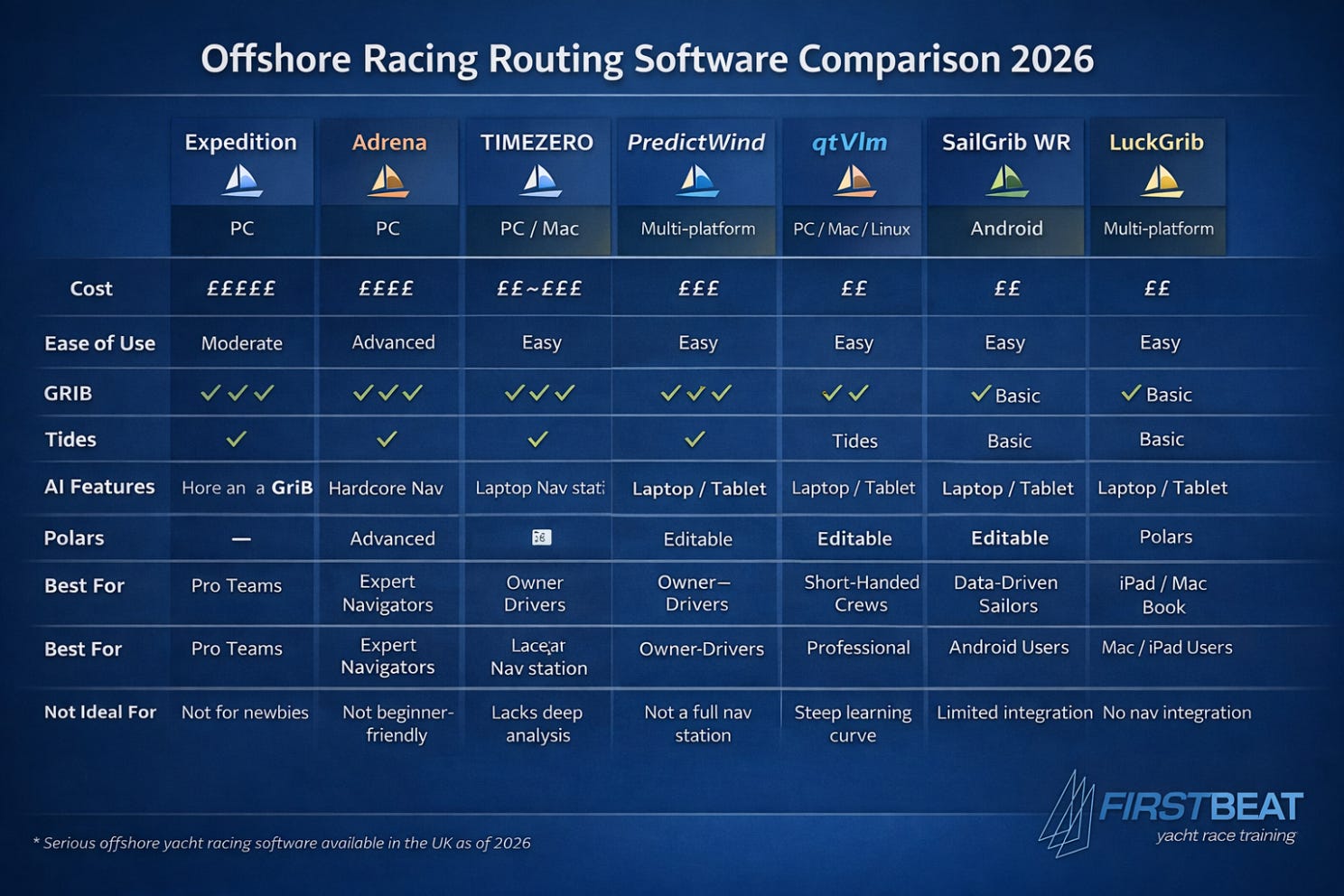
So how do they compare where it really matters?
On cost, Expedition and Adrena Pro sit firmly at the premium end, with TZ Professional also in the higher bracket once software, routing modules and charts are included. PredictWind is materially cheaper as a subscription ecosystem. qtVlm, SailGrib WR and LuckGrib are dramatically cheaper entry points, while Squid sits somewhere in the middle depending on subscription level and whether the team is using mobile or desktop.
On hardware, Expedition, Adrena and TZ Professional want a proper Windows machine and reward a proper installation. PredictWind, LuckGrib, SailGrib and Squid are much friendlier to mobile or mixed-device setups. qtVlm is the outlier because it can live almost anywhere, from a conventional PC to Raspberry Pi to tablet.
On ease of use, the simplest learning curves generally belong to PredictWind, LuckGrib and Squid mobile, with SailGrib also strong once the user accepts its Android-centred logic. Expedition and Adrena are more demanding but more expandable. qtVlm is excellent, but not especially forgiving. That last point is an inference based on the product structures, technical feature density and how these systems are positioned, rather than a claim any one vendor would make about itself.
On handling multiple GRIBs and weather comparison, Expedition and PredictWind are particularly strong because both expose users to multiple forecast products and comparisons; Expedition’s version history now includes ensemble and AIFS-related additions, while PredictWind explicitly routes across multiple models. Squid also leans heavily into multi-model weather. qtVlm’s flexibility and its ability to work with different weather/current inputs also make it powerful in practiced hands.
On current and tide use, Expedition, Adrena, TIMEZERO, qtVlm, SailGrib and LuckGrib all support current-aware routing in one form or another, but the practical distinction is how transparent and editable that process is for the navigator. In UK offshore racing, that transparency matters because tide often decides the race long before the final weather picture does.
On polars and velocity profiles, the traditional race leaders still have the most race-campaign credibility. Adrena Pro explicitly highlights creation and adjustment of speed polars; Expedition has long been built around performance analysis; TIMEZERO, PredictWind, qtVlm, SailGrib and Squid all rely heavily on the quality of boat polars, while PredictWind’s AI Polars are one of the more interesting attempts to automate improvement of those inputs from real data.
What AI is actually changing onboard
The fashionable answer is that AI is changing everything. The honest answer is more modest and more useful. AI is not replacing the navigator. It is improving some of the inputs and some of the assumptions. The three big areas are forecast generation, forecast blending/comparison, and polar refinement from observed boat data. ECMWF’s AIFS becoming operational matters because it gives routing platforms another serious forecast source. PredictWind’s addition of AI-related forecast products and AI Polars matters because it tackles forecast choice and boat-performance realism, which are two of the main reasons routing fails in practice. Adrena’s integration with SEA.AI matters more for broader onboard intelligence and safety than for direct weather routing, but it is part of the same trend: the onboard decision stack is becoming more connected and more intelligent.
The point offshore is not to worship AI. It is to use it where it tightens the loop between forecast, actual conditions and boat performance. If AI helps a router use more realistic boat-speed assumptions, or gives the navigator one more credible large-scale model to compare against, that is valuable. If it merely produces a shinier picture and convinces the crew to stop thinking, it is dangerous.
The Firstbeat view: what I would recommend
If I were advising a well-campaigned offshore race boat with a proper navigator and the budget to do the job correctly, I would still start with Expedition, and I would look seriously at Adrena Pro if the team wanted a different flavour of high-end analytical routing and performance work. Those remain the most complete “serious nav desk” solutions.
If I were advising an ambitious owner-driver team, a short-handed programme, or a campaign that wants strong routing without turning the boat into a floating IT rack, I would look very closely at PredictWind, qtVlm, and Squid, depending on the crew’s appetite for complexity and their preferred hardware. PredictWind is the easiest route into a strong modern ecosystem; qtVlm is the value weapon for the technically confident; Squid is perhaps the most interesting forward-looking option.
If the brief is Apple-first, I would have LuckGrib high on the list. If the brief is Android-first and cost-sensitive but still offshore-serious, SailGrib WR deserves more respect than it usually gets.
And if I were coaching any crew on any of these systems, I would finish with the same warning. Routing software does not win offshore races on its own. It helps good sailors ask better questions. The winning crews are still the ones who understand the weather structure, know when to distrust the line, update their performance assumptions honestly, and use routing as a decision-support tool rather than a substitute for seamanship. In 2026 the software is getting smarter. That makes it even more important that the crew does too.
Top-tier race navigation systems
Expedition Website: Visit Expedition Marine The benchmark offshore racing navigation platform, widely used in Volvo Ocean Race and America’s Cup campaigns
Adrena Website: Visit Adrena Software High-end routing and performance analysis software designed specifically for offshore racing
TIMEZERO Professional Website: Visit TIMEZERO Professional navigation platform with integrated routing, charts and weather ecosystem
Modern multi-platform / hybrid systems
PredictWind Website: Visit PredictWind Multi-model weather routing platform with strong offshore and satellite capability
qtVlm Website:
https://www.meltemus.com
Highly flexible multi-platform routing tool (PC, Mac, Linux, mobile)
Squid Website:
https://www.squid-sailing.com
Emerging routing and weather platform used in high-end offshore racing ecosystems
Mobile-first / lightweight routing systems
SailGrib WR Website: Visit SailGrib Android-based routing app with strong GRIB, tide and offline capability
LuckGrib Website: Visit LuckGrib Apple-based GRIB and routing system with offshore optimisation and satellite workflows
Final thought:
The new generation of routing tools is extraordinary. But the better the software gets, the more dangerous it becomes for crews who do not understand weather, tide, polars and uncertainty.
Post script:
New entry to market: Navimetrix
Strengths
NavimetriX looks like one of the more interesting newer routing platforms because it is genuinely multi-platform, working across iOS, Android, macOS and Windows, with cloud sync between devices. That matters for crews who want to plan at home, brief on a tablet and then use the same project onboard. Its Premium subscription includes a wide selection of weather models, forecasts up to 15 days, wave and current forecasts, routing up to 15 days, NMEA/GPS connection and AIS target processing.
Its routing feature set is stronger than a simple app. It can use polars from a library, import or calculate polars, include wind, waves and currents, adjust routing style, use pivot points and generate AI weather briefings. It also supports multi-GRIB routing, where higher-resolution short-range models can be used near the start and longer-range models take over later, which is very relevant for races that start in complex coastal weather and then move offshore.
The price is attractive. At €79.99 per year for Premium, it sits well below Expedition, Adrena or TIMEZERO Professional, which makes it a serious option for owner-driver boats, short-handed sailors and crews who want proper routing without building a full Windows nav desk.
Weaknesses
It is still a relatively new platform, so I would be cautious about putting it in the same “proven race campaign” category as Expedition or Adrena. The serious grand-prix navigation world tends to reward software that has been hammered for years by navigators, instrument suppliers and race teams. NavimetriX may get there, but it still needs time and wider offshore-racing evidence.
Charting is an extra complication. NavimetriX uses GeoGarage charts, and the FAQ says nautical charts are not included in the Premium subscription, so you need additional GeoGarage subscriptions. UKHO charts are listed at around €70 per year, SHOM around €60, BSH around €25 and NOAA around €4. That is not a deal-breaker, but owners need to know the headline app price is not the full navigation cost.
There may also be some feature maturity issues. The FAQ roadmap shows items being rolled out across 2026, including polar editor, dual-screen mode, ensemble routing, automatic backup and other features, so the product is clearly developing fast, but that also means users need to check which features are actually live on their device and not just planned.
Opportunities
NavimetriX could sit in a very useful space between consumer weather apps and full race-navigation suites. For many RORC, JOG and IRC crews, Expedition may be too much and PredictWind may not feel integrated enough as a navigation environment. NavimetriX’s opportunity is to become the practical, modern, multi-device racing and cruising platform that gives serious routing, weather, AIS, NMEA and charts without the full Expedition learning curve.
The multi-GRIB workflow is particularly promising for UK offshore racing, where a navigator may want AROME or ARPEGE near the start, then GFS or ECMWF further offshore. NavimetriX’s FAQ describes exactly that kind of routing handover between higher-resolution short-range GRIBs and longer-range models.
The AI weather briefing feature could also become valuable, provided it remains a briefing aid rather than something crews blindly trust. Used properly, it could help owner-driver crews summarise model differences and prepare faster.
Threats
The main threat is competition. Expedition and Adrena remain the serious race-nav benchmarks. PredictWind has huge weather-routing reach and a strong ecosystem. qtVlm is powerful and inexpensive. SailGrib and LuckGrib serve mobile-first users well. NavimetriX has to prove why it is better than “PredictWind plus charts” or “qtVlm plus discipline” for a specific crew.
The second threat is overconfidence. Because the interface appears modern and easy to use, there is a danger that sailors may treat the route output as more certain than it is. Like every routing tool, NavimetriX is only as good as the GRIBs, current data, polars and assumptions behind it.
FirstBeat view
NavimetriX looks like a serious emerging option, especially for sailors who want a modern multi-platform workflow with routing, weather, AIS, NMEA and charts in one place. I would not yet put it ahead of Expedition or Adrena for a fully campaigned offshore race boat with a dedicated navigator, but for many ambitious amateur offshore crews it may be one of the most useful tools to test in 2026.
Stuart Greenfield
FirstBeat — Offshore Racing Intelligence
From first beat to first place.Offshore racing is never just about the boat, the forecast, or the routing software.
It is about decisions made under pressure, in changing conditions, by tired people trying to keep the boat moving fast and safely in the right direction.
That is where races are won and lost.
At FirstBeat, my aim is simple: to help owners, skippers and crews race offshore with more clarity, more confidence, and better preparation — whether that is a RORC Channel race, a Fastnet campaign, or your first serious step into offshore racing.
If this article helped you think a little more clearly about the next race, please consider subscribing.
Free subscribers receive regular offshore racing notes, tactical insights, safety thinking, and race-preparation ideas.
Paid subscribers help support the work and receive deeper analysis, including more detailed race briefings, tactical notes, routing thoughts, and practical offshore performance intelligence.
Thanks for reading.
