

Why TWA matters offshore -
Why true wind angle is the core offshore reference, and when apparent wind still matters and why I'm writing this update as questions have been asked.

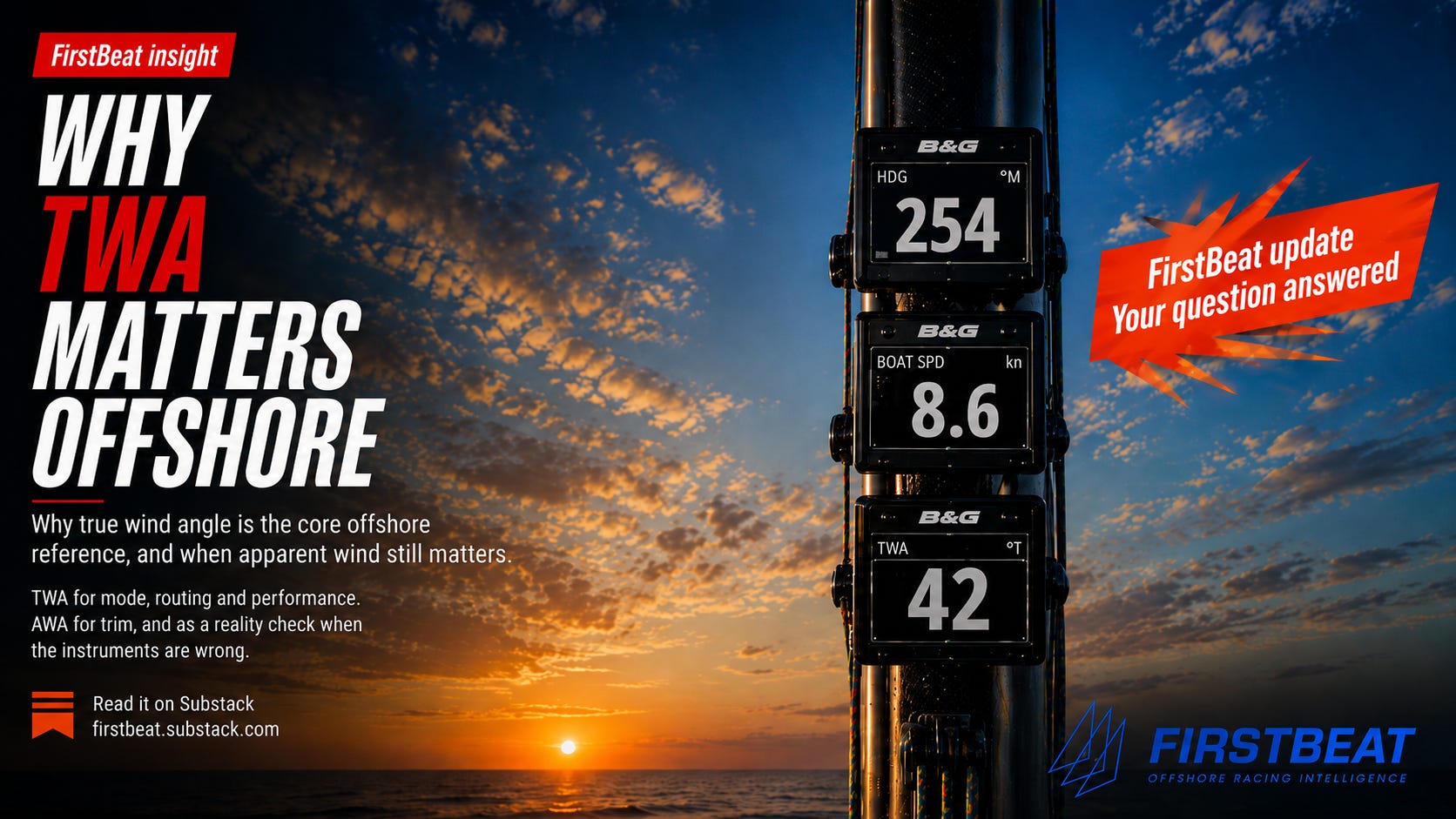
After the Morgan Cup, one of the crew asked me a very good question about why I normally want TWA, True Wind Angle, as one of the core numbers on the mast instruments offshore, when many sailors, especially those who race inshore, are more used to looking at AWA, Apparent Wind Angle.
His logic was perfectly sound. The sails are trimmed to the wind they actually feel, and that wind is apparent wind. The telltales, leech, twist, sheet load, helm balance and the general feel of the boat all respond to apparent wind, so it is completely understandable that someone coming from a lot of inshore racing would expect AWA to be the main number in front of the helm.
But offshore, the job of the instruments is slightly different.
The answer is not that AWA is wrong, or that TWA is somehow a better number in every situation. The answer is that AWA and TWA do different jobs, and if you confuse those jobs you can end up sailing the boat in a way that feels right moment by moment, but is not necessarily right for the leg, the target, the routing or the race.
AWA tells you what the sails are feeling now. TWA tells you what the boat is doing in relation to the actual wind system around it. That distinction matters offshore because the boat is no longer just being trimmed for the next few seconds. It is being managed over hours.
Inshore, AWA can be a perfectly sensible primary number. The legs are short, the crew are close together, the trimmers are constantly working, and many of the decisions are immediate. You are trying to hold a lane, accelerate out of a tack, defend a position, squeeze over a boat to leeward, or judge whether you can cross. In that world, apparent wind is a very useful language because the boat is being sailed through short, intense, highly reactive phases where trim, feel and acceleration dominate the conversation.
Offshore is different because you are not just trying to make the boat feel right in the next gust or wave. You are trying to keep the boat in the correct mode for long periods, compare actual performance against target performance, manage fatigue, choose the right sail, understand the sea state, make VMG and VMC decisions, and keep the helm, navigator, tactician and trimmers working from the same reference.
That is where TWA earns its place.
Polars are written in true wind. Routing software works from true wind. Target speeds and target angles are normally expressed in true wind. VMG and VMC decisions make more sense in true wind because they are about the boat’s performance against the real wind field, not just the air the sails are feeling as the boat moves through it. If the navigator is thinking in TWA, the polars are built around TWA, the routing is using TWA, but the helm is sailing mainly to AWA, the boat is not quite speaking one language.
That may sound like a small issue, but offshore, over hours, in the dark, wet and tired, small errors in language become small errors in judgement, and small errors in judgement eventually become performance losses.
The other problem with apparent wind is that it is reactive. It changes every time the boat speed changes because apparent wind is made from the true wind plus the boat’s own movement through the air. When an upwind boat accelerates, the apparent wind moves forward and the AWA becomes smaller than the TWA. For example, if the true wind speed is 12 knots, the boat is making 6 knots, and the boat is sailing at 42 degrees true, the apparent wind may be around 16.9 knots at about 28 degrees apparent. The sails feel the 28-degree apparent wind, but the race decision is still being made against the 42-degree true wind angle.
That is why this can become confusing if you do not separate the two ideas clearly. Apparent wind is what powers and trims the sails, but it is also being altered by the boat’s own speed. The faster the boat goes, the more the apparent wind is affected by that forward motion. On a reach or downwind in waves, apparent wind can also move around significantly as the boat accelerates, checks, surfs or slows. If the helm or pilot starts chasing every movement in AWA, the boat can end up responding to changes that are partly self-created rather than changes in the actual wind.
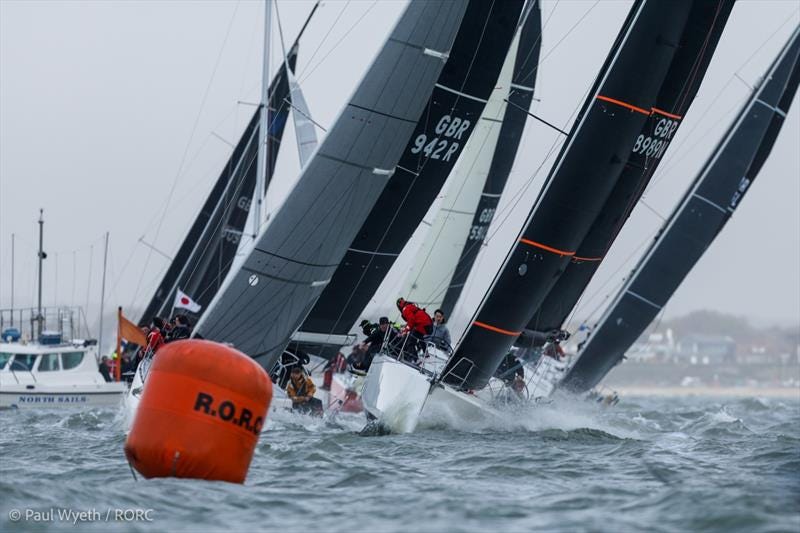
That is one of the quiet traps of offshore sailing. You think you are steering to the wind, but you may partly be steering to the boat’s own acceleration and deceleration.
TWA gives the helm a more stable frame of reference because it allows you to ask a better offshore question: are we sailing the right relationship to the true wind for this sail, this sea state, this leg, this tide and this tactical problem?
That is why, offshore, I like the core mast display to remain brutally simple. For me, the helm needs heading, boatspeed and true wind angle. Heading tells us where we are pointing, boatspeed tells us whether the boat is alive, and TWA tells us whether we are sailing the right mode. Those three numbers do not tell you everything, but they tell you enough to keep the boat disciplined, and they are simple enough to read at a glance in spray, darkness, fatigue and bad weather.
That matters more than people think. A mast display should not be a Christmas tree. If every available number is thrown at the helm, the useful information gets diluted, and the tired brain starts looking rather than sailing. Offshore, the display should simplify the job, not decorate it.
None of this means AWA disappears. Far from it. AWA remains vital for trimming because it is what the sails are actually feeling. A trimmer looking at jib telltales, leech tension, twist, sheet load and helm balance is working in the apparent wind. The boat’s feel is apparent. The sail’s reaction is apparent. The immediate trim conversation is apparent.
So the split is simple, but important. AWA is for trim and feel, while TWA is for mode, performance and strategy. If you are trimming the jib, AWA matters. If you are deciding whether the boat is sailing the right angle for the next three hours, TWA matters more.
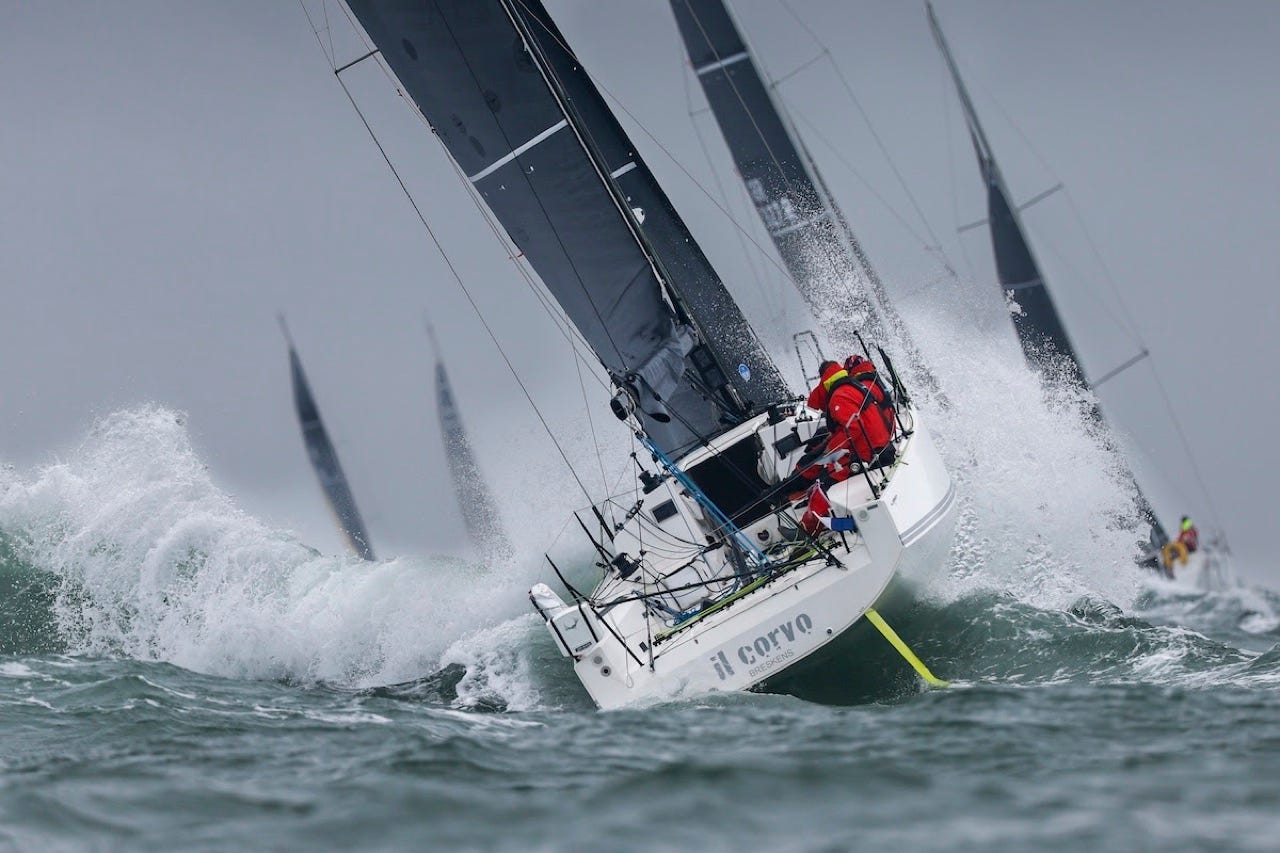
The Morgan Cup question also raised another important point, which is what happens when the instruments are wrong. This is where blind faith in TWA becomes dangerous, because true wind is not directly measured. It is calculated. The instrument system takes apparent wind, boatspeed, heading and calibration data, then produces a true wind number. If those inputs are poor, the true wind number can be poor as well.
If the log is dirty, the masthead unit is misaligned, the compass is wrong, the wind angle calibration is poor from tack to tack, or the boat speed is suspect, TWA can look beautifully precise while being quietly wrong. That is worse than useless because it gives confidence where caution is required.
On a well-calibrated offshore boat, TWA should be a core mast number. On a badly calibrated or unverified boat, TWA should be treated with suspicion, and that is where AWA becomes more than just a trim number. It becomes a reality check.
If the true wind numbers do not make sense from tack to tack, look at AWA. Look at the telltales, boatspeed, heading, heel, sea state, other boats, wake and the feel of the helm. Ask whether the boat actually feels right, because the screen is there to support judgement, not replace it.
Before a serious race, the instrument system deserves proper attention. Boatspeed should be checked, wind angle should be checked on both tacks, compass behaviour should be checked, and true wind direction should not jump wildly every time you tack. The numbers should make sense as a system. If they do, TWA becomes extremely powerful. If they do not, the display may be lying to you in a very expensive-looking font.
One of the crew produced some tables after the Morgan Cup showing how much extra boatspeed would be needed to justify bearing away by different amounts. That is exactly the sort of thinking good offshore crews should be doing, because it turns a vague feeling into a performance question. What angle are we sailing? What speed should we be making? What VMG or VMC are we gaining or losing? Does sailing lower actually pay, or does it just feel faster?
That calculation is much cleaner in true wind because true wind gives you the performance framework. An AWA-based version of the same exercise quickly becomes messy because every change in boatspeed changes the apparent angle. The table starts chasing its own tail.
This is the distinction I think many sailors miss. Apparent wind is what the boat feels, but true wind is what the race is being sailed in. The best offshore crews use both. They trim to apparent wind, feel and telltales, but they make mode, routing and performance decisions in true wind, while constantly checking the numbers against reality.
That is the whole point.
The instruments should not turn sailors into passengers staring at screens. They should help good sailors make better decisions. They should simplify the boat, not complicate it. They should give the helm, navigator and trimmers a common language, especially when tired brains are trying to make decent decisions at three in the morning.
So, after the Morgan Cup, and for 18 hours (2026) it was tought upwind race, my answer is this. If you are sailing short inshore legs with active trimming and constant tactical reactions, AWA may be the most natural number to show. If you are racing offshore, managing performance over time, comparing the boat against polars, working with routing, judging mode and trying to keep the helm and navigator aligned, TWA should be one of the core numbers.
But only if it is calibrated.
If it is not calibrated, AWA, telltales, heading, boatspeed and the feel of the boat may tell you more truth than a calculated true wind number. That is not a contradiction. That is seamanship.
Read the original full instruments article here:Full article
How I Set Up Race Instruments Offshore
Stuart Greenfield
FirstBeat — Offshore Racing Intelligence
From first beat to first place.
Offshore racing is never just about the boat, the forecast, or the routing software.
It is about decisions made under pressure, in changing conditions, by tired people trying to keep the boat moving fast and safely in the right direction.
That is where races are won and lost.
At FirstBeat, my aim is simple: to help owners, skippers and crews race offshore with more clarity, more confidence, and better preparation — whether that is a RORC Channel race, a Fastnet campaign, or your first serious step into offshore racing.
If this article helped you think a little more clearly about the next race, please consider subscribing.
Free subscribers receive regular offshore racing notes, tactical insights, safety thinking, and race-preparation ideas.
Paid subscribers help support the work and receive deeper analysis, including more detailed race briefings, tactical notes, routing thoughts, and practical offshore performance intelligence.
Thanks for reading.

Hi Stuart, thanks for this article - I was literally asking myself the same question the other day. Not because I was used to AWA but because of a specific experience I actually had and thought might be worth adding as a comment: On the Myth of Malham, we made a tactical decision to go south to avoid a wind hole just before the finish. This worked pretty well until we found another wind hole that wasn't in the forecast, right in front of the Needles. I was helming the boat as I always do in no wind, just trying to get it going based on feeling. As my co-skipper was up, I got all his comments, "you're at 90 TWA, can you not come up??" No, I can't - if I want to keep the boat moving. As the boat picked up speed, I could slowly come up. Thinking about it, it occurred to me this was me creating my own apparent - and that maybe looking at AWA would actually be useful here! And it was.. I've never worked with AWA tbh, but I have now created a page on our B&G to display it because I have found that in absolute nothingness of wind, it's a really useful orientation!
The second comment I wanted to make is regarding calibration... And I'm sure this is different by manufacturer. But I also always thought that AWA would be more reliable than TWA if the calibration is off. However, at a seminar on calibration with B&G, they actually explained to us that AWA is just as calculated... What isn't calculated is Measured Wind, and then from there they calculate TWA and TWD - and essentially calculate AWA by deducting log and heading from it again... From what I understood, they would not treat it as more reliable than TWA, which is a shame.